Tsunamis A tsunami is an ocean wave often caused by earthquakes on the ocean floor; these waves typically have long wavelengths, ranging from 150 to 1000 km. Imagine a tsunami traveling across the Pacific Ocean, which is the deepest ocean in the world, with an average depth of about 4000 m. Explain why the shallow-water velocity equation (Exercise 75) applies to tsunamis even though the actual depth of the water is large. What does the shallow-water equation say about the speed of a tsunami in the Pacific Ocean (use d = 4000 m)?
Table of contents
- 0. Functions7h 55m
- Introduction to Functions18m
- Piecewise Functions10m
- Properties of Functions9m
- Common Functions1h 8m
- Transformations5m
- Combining Functions27m
- Exponent rules32m
- Exponential Functions28m
- Logarithmic Functions24m
- Properties of Logarithms36m
- Exponential & Logarithmic Equations35m
- Introduction to Trigonometric Functions38m
- Graphs of Trigonometric Functions44m
- Trigonometric Identities47m
- Inverse Trigonometric Functions48m
- 1. Limits and Continuity2h 2m
- 2. Intro to Derivatives1h 33m
- 3. Techniques of Differentiation3h 18m
- 4. Applications of Derivatives2h 38m
- 5. Graphical Applications of Derivatives6h 2m
- 6. Derivatives of Inverse, Exponential, & Logarithmic Functions2h 37m
- 7. Antiderivatives & Indefinite Integrals1h 26m
- 8. Definite Integrals4h 44m
- 9. Graphical Applications of Integrals2h 27m
- 10. Physics Applications of Integrals 3h 16m
- 11. Integrals of Inverse, Exponential, & Logarithmic Functions2h 31m
- 12. Techniques of Integration7h 41m
- 13. Intro to Differential Equations2h 55m
- 14. Sequences & Series5h 36m
- 15. Power Series2h 19m
- 16. Parametric Equations & Polar Coordinates7h 58m
0. Functions
Common Functions
Struggling with Calculus?
Join thousands of students who trust us to help them ace their exams!Watch the first videoMultiple Choice
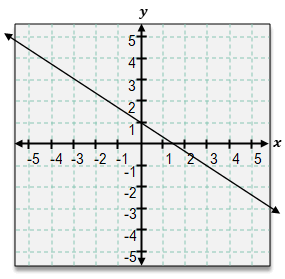
In the graph shown, identify the y–intercept & slope. Write the equation of this line in Slope-Intercept form.

A
y=32x+1
B
y=−32x+1
C
y=−2x+1
D
y=x+2
Verified step by step guidance1
First, identify the y-intercept of the line on the graph. The y-intercept is the point where the line crosses the y-axis. In this graph, the line crosses the y-axis at y = 1.
Next, determine the slope of the line. The slope is calculated as the change in y divided by the change in x between two points on the line. Choose two points on the line, such as (0, 1) and (3, -1).
Calculate the slope using the formula: slope = (y2 - y1) / (x2 - x1). Substitute the chosen points into the formula: slope = (-1 - 1) / (3 - 0) = -2/3.
Now, write the equation of the line in slope-intercept form, which is y = mx + b, where m is the slope and b is the y-intercept. Substitute the slope and y-intercept into the equation: y = -2/3x + 1.
Verify the equation by checking if other points on the line satisfy the equation. For example, check if the point (3, -1) satisfies the equation: y = -2/3(3) + 1 = -2 + 1 = -1, which is correct.
Watch next
Master Graphs of Common Functions with a bite sized video explanation from Patrick
Start learningRelated Videos
Related Practice
Textbook Question
16
views
Common Functions practice set

