Ch. 3 - Derivatives
Briggs - Calculus: Early Transcendentals 3rd Edition
Briggs3rd EditionCalculus: Early TranscendentalsISBN: 9780136847243Not the one you use?Change textbook
Chapter 3, Problem 70b

The following equations implicitly define one or more functions.
b. Solve the given equation for y to identify the implicitly defined functions y=f₁(x), y = f₂(x), ….
y² = x²(4 − x) / 4 + x (right strophoid)

Verified step by step guidance
1
Start by isolating the term involving y on one side of the equation. The given equation is y² = x²(4 − x) / 4 + x. We need to solve for y, so we have y² = (x²(4 − x) / 4) + x.
To solve for y, take the square root of both sides of the equation. This gives us y = ±√((x²(4 − x) / 4) + x). Remember that taking the square root introduces both positive and negative solutions.
Now, express the solutions as functions of x. We have two functions: y = f₁(x) = √((x²(4 − x) / 4) + x) and y = f₂(x) = -√((x²(4 − x) / 4) + x).
Consider the domain of the functions. Since we are taking the square root, the expression inside the square root must be non-negative. Set up the inequality (x²(4 − x) / 4) + x ≥ 0 and solve for x to find the domain.
Verify the solutions by substituting back into the original equation to ensure they satisfy y² = x²(4 − x) / 4 + x. This step confirms that the functions y = f₁(x) and y = f₂(x) are correctly derived from the implicit equation.

Verified video answer for a similar problem:

This video solution was recommended by our tutors as helpful for the problem above.
Video duration:
3m
Was this helpful?

Key Concepts

Here are the essential concepts you must grasp in order to answer the question correctly.

Implicit Functions

Implicit functions are defined by equations where the dependent variable is not isolated on one side. In the context of calculus, these functions can often be expressed in terms of the independent variable through algebraic manipulation. Understanding how to manipulate these equations is crucial for identifying the functions they define.
Recommended video:
05:14
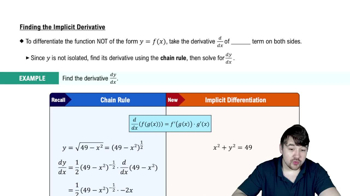
Finding The Implicit Derivative

Algebraic Manipulation

Algebraic manipulation involves rearranging and simplifying equations to isolate variables. This skill is essential when solving for y in an implicit equation, as it allows one to express y explicitly in terms of x. Techniques such as factoring, expanding, and using the quadratic formula may be necessary to achieve this.
Recommended video:
05:25
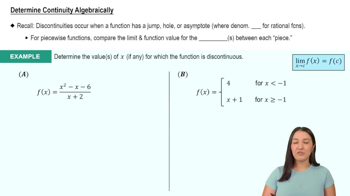
Determine Continuity Algebraically

Quadratic Equations

Quadratic equations are polynomial equations of the form ax² + bx + c = 0, where a, b, and c are constants. In the context of the given equation, recognizing that it can be rearranged into a quadratic form in terms of y is vital. Solutions to quadratic equations can yield multiple values for y, representing different branches of the implicitly defined function.
Recommended video:
5:02
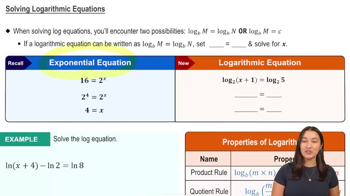
Solving Logarithmic Equations
Related Practice
Textbook Question

Find f′(x), f′′(x), and f′′′(x) for the following functions.

f(x) = (x2 - 7x - 8) / (x + 1)

291
views

Textbook Question

The right-sided and left-sided derivatives of a function at a point aa are given by f+(a)=limh0+f(a+h)f(a)hf_{+}^{\(\prime\)}\(\left\)(a\(\right\))={\(\displaystyle\]\lim\)_{h\(\to\)0^{+}}{\(\frac{f(a+h)-f(a)}{h}\)}} and f(a)=limh0f(a+h)f(a)hf_{-}^{\(\prime\)}\(\left\)(a\(\right\))={\(\displaystyle\]\lim\)_{h\(\to\)0^{-}}{\(\frac{f(a+h)-f(a)}{h}\)}}, respectively, provided these limits exist. The derivative f(a)f^{\(\prime\)}\(\left\)(a\(\right\)) exists if and only if f+(a)=f(a)f_{+}^{\(\prime\)}\(\left\)(a\(\right\))=f_{-}^{\(\prime\)}\(\left\)(a\(\right\)).

Compute f+(a)f_{+}^{\(\prime\)}\(\left\)(a\(\right\)) and f(a)f_{-}^{\(\prime\)}\(\left\)(a\(\right\)) at the given point aa.

f(x)=x2f\(\left\)(x\(\right\))=\(\left\)|x-2\(\right\)|; a=2a=2

260
views
Textbook Question

Calculate the derivative of the following functions.

y = e^2x(2x-7)⁵

399
views
Textbook Question

The following equations implicitly define one or more functions.

c. Use the functions found in part (b) to graph the given equation.

y² = x²(4 − x) / 4 + x (right strophoid)

209
views
Textbook Question

The following equations implicitly define one or more functions.

a. Find dy/dx using implicit differentiation.

y² = x²(4 − x) / 4 + x (right strophoid)

202
views
Textbook Question

The following equations implicitly define one or more functions.

c. Use the functions found in part (b) to graph the given equation.

x+y³−xy=1 (Hint: Rewrite as y³−1=xy−x and then factor both sides.)

271
views