Ch. 3 - Derivatives
Briggs - Calculus: Early Transcendentals 3rd Edition
Briggs3rd EditionCalculus: Early TranscendentalsISBN: 9780136847243Not the one you use?Change textbook
Chapter 3, Problem 3

The function s(t)s(t) represents the position of an object at time t moving along a line. Suppose s(2)=136s(2)=136 and s(3)=156s(3)=156 . Find the average velocity of the object over the interval of time [2,3][2, 3] .

Verified step by step guidance
1
Identify the formula for average velocity over a time interval [a, b], which is given by the change in position divided by the change in time: \( v_{avg} = \frac{s(b) - s(a)}{b - a} \).
Substitute the given values into the formula. Here, \( a = 2 \) and \( b = 3 \), so the formula becomes \( v_{avg} = \frac{s(3) - s(2)}{3 - 2} \).
Use the provided position values: \( s(2) = 136 \) and \( s(3) = 156 \).
Substitute these values into the equation: \( v_{avg} = \frac{156 - 136}{3 - 2} \).
Simplify the expression to find the average velocity: \( v_{avg} = \frac{20}{1} \).

Verified video answer for a similar problem:

This video solution was recommended by our tutors as helpful for the problem above.
Video duration:
3m
Was this helpful?

Key Concepts

Here are the essential concepts you must grasp in order to answer the question correctly.

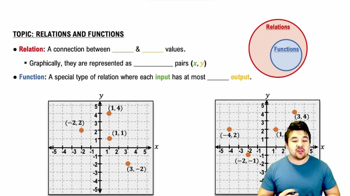
Position Function

The position function, denoted as s(t), describes the location of an object along a line at a specific time t. It provides a mathematical representation of the object's movement, allowing us to analyze its behavior over time. Understanding this function is crucial for determining other properties, such as velocity and acceleration.
Recommended video:
5:20
Relations and Functions

Average Velocity

Average velocity is defined as the change in position divided by the change in time over a specific interval. Mathematically, it is calculated using the formula (s(b) - s(a)) / (b - a), where [a, b] is the time interval. This concept is essential for understanding how fast an object is moving on average during that time period.
Recommended video:
06:37
Average Value of a Function

Interval Notation

Interval notation is a mathematical way to represent a range of values, often used to specify the domain of a function or the limits of integration. In this context, the interval [2, 3] indicates that we are considering the time from t = 2 to t = 3, inclusive. Recognizing how to interpret and use interval notation is important for solving problems related to motion and calculus.
Recommended video:
04:22
Sigma Notation