Graph the functions in Exercises 37–46. What symmetries, if any, do the graphs have? Specify the intervals over which the function is increasing and the intervals where it is decreasing.
y = x³/8
Verified step by step guidance
1
First, identify the function given: \( y = \frac{x^3}{8} \). This is a cubic function, which is generally of the form \( y = ax^3 + bx^2 + cx + d \). In this case, \( a = \frac{1}{8} \), \( b = 0 \), \( c = 0 \), and \( d = 0 \).
To determine the intervals of increase and decrease, find the first derivative of the function. The derivative \( y' \) of \( y = \frac{x^3}{8} \) is \( y' = \frac{3x^2}{8} \).
Analyze the first derivative \( y' = \frac{3x^2}{8} \). Since \( 3x^2 \) is always non-negative and \( \frac{1}{8} \) is positive, \( y' \geq 0 \) for all \( x \). This indicates that the function is non-decreasing everywhere.
Since the derivative is zero only at \( x = 0 \), the function is constant at this point and increasing elsewhere. Therefore, the function is increasing on the intervals \( (-\infty, 0) \) and \( (0, \infty) \).
Check for symmetries: The function \( y = \frac{x^3}{8} \) is an odd function because \( f(-x) = -f(x) \). This means the graph is symmetric with respect to the origin.
Verified video answer for a similar problem:
This video solution was recommended by our tutors as helpful for the problem above
Video duration:
4m
Play a video:
0 Comments
Key Concepts
Here are the essential concepts you must grasp in order to answer the question correctly.
Increasing and Decreasing Functions
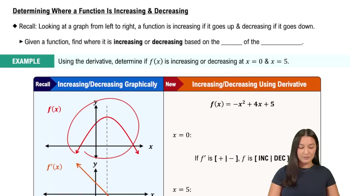
A function is increasing on an interval if, for any two numbers in that interval, a larger input results in a larger output. Conversely, it is decreasing if a larger input results in a smaller output. To determine these intervals, one typically examines the sign of the derivative: positive for increasing and negative for decreasing.
Determining Where a Function is Increasing & Decreasing
Symmetry in Graphs
Symmetry in graphs refers to the property where a graph is invariant under certain transformations, such as reflection or rotation. Common types include even symmetry (y-axis symmetry) and odd symmetry (origin symmetry). For the function y = x³/8, checking for odd symmetry involves verifying if f(-x) = -f(x).
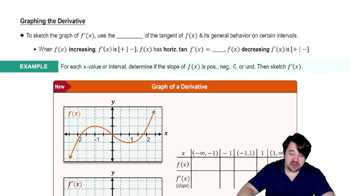
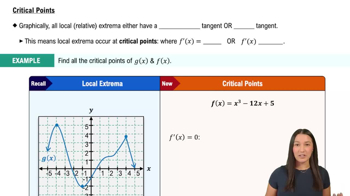
The derivative of a function provides information about its rate of change. Critical points occur where the derivative is zero or undefined, indicating potential local maxima, minima, or points of inflection. For y = x³/8, the derivative y' = (3/8)x² helps identify intervals of increase or decrease by analyzing where it is positive or negative.