For Exercises 51–54, solve for the angle θ, where 0 ≤ θ ≤ 2π.
cos 2θ + cos θ = 0
Verified step by step guidance
1
Start by using the double angle identity for cosine: \( \cos 2\theta = 2\cos^2\theta - 1 \). Substitute this into the equation to get \( 2\cos^2\theta - 1 + \cos\theta = 0 \).
Rearrange the equation to form a quadratic in terms of \( \cos\theta \): \( 2\cos^2\theta + \cos\theta - 1 = 0 \).
Let \( x = \cos\theta \). The equation becomes \( 2x^2 + x - 1 = 0 \). Solve this quadratic equation using the quadratic formula: \( x = \frac{-b \pm \sqrt{b^2 - 4ac}}{2a} \), where \( a = 2 \), \( b = 1 \), and \( c = -1 \).
Calculate the discriminant \( b^2 - 4ac \) and find the roots \( x_1 \) and \( x_2 \). These roots represent the possible values for \( \cos\theta \).
For each root, determine the corresponding angle \( \theta \) within the interval \( 0 \leq \theta \leq 2\pi \) by considering the unit circle and the possible quadrants where cosine is positive or negative.
Verified video answer for a similar problem:
This video solution was recommended by our tutors as helpful for the problem above
Video duration:
6m
Play a video:
Was this helpful?
Key Concepts
Here are the essential concepts you must grasp in order to answer the question correctly.
Trigonometric Identities
Trigonometric identities are equations involving trigonometric functions that are true for all values of the variable. In this problem, the double angle identity for cosine, cos(2θ) = 2cos²(θ) - 1, can be useful to simplify the equation. Understanding these identities is crucial for manipulating and solving trigonometric equations.
Solving trigonometric equations involves finding the angles that satisfy the equation within a specified interval. In this case, we need to find values of θ that make the equation cos(2θ) + cos(θ) = 0 true, specifically within the range 0 ≤ θ ≤ 2π. This often requires using algebraic techniques and understanding the properties of trigonometric functions.
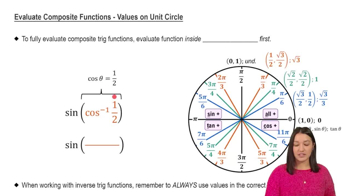
The unit circle is a fundamental concept in trigonometry that helps visualize the values of sine and cosine for different angles. It provides a geometric interpretation of trigonometric functions, where the x-coordinate represents cos(θ) and the y-coordinate represents sin(θ). Understanding the unit circle is essential for determining the angles that correspond to specific trigonometric values, especially when solving equations.