
Textbook Question
23–38. Divergence, Integral, and p-series Tests Use the Divergence Test, the Integral Test, or the p-series test to determine whether the following series converge.
∑ (k = 1 to ∞) k^(–1/5)
66
views

 Verified step by step guidance
 05:35
05:35
 07:15
07:15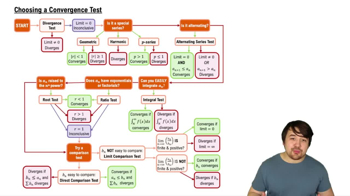 07:51
07:5123–38. Divergence, Integral, and p-series Tests Use the Divergence Test, the Integral Test, or the p-series test to determine whether the following series converge.
∑ (k = 1 to ∞) k^(–1/5)
9–15. Geometric sums Evaluate each geometric sum.
{Use of Tech}∑ k = 0 to 20(2/5)²ᵏ
Growth rates of sequences
Use Theorem 10.6 to find the limit of the following sequences or state that they diverge.
aₙ = (6ⁿ + 3ⁿ) / (6ⁿ + n¹⁰⁰)
13–20. Explicit formulas Write the first four terms of the sequence { aₙ }∞ₙ₌₁.
aₙ = 1 + sin(πn / 2)
72–86. Evaluating series Evaluate each series or state that it diverges.
∑ (k = 1 to ∞) (((1/6)ᵏ + (1/3)ᵏ) × k⁻¹)
40–62. Choose your test Use the test of your choice to determine whether the following series converge.
∑ (k = 1 to ∞) k⁸ / (k¹¹ + 3)