Suppose a power series converges if |x−3|<4 and diverges if |x−3| ≥ 4. Determine the radius and interval of convergence.
Table of contents
- 0. Functions7h 54m
- Introduction to Functions16m
- Piecewise Functions10m
- Properties of Functions9m
- Common Functions1h 8m
- Transformations5m
- Combining Functions27m
- Exponent rules32m
- Exponential Functions28m
- Logarithmic Functions24m
- Properties of Logarithms36m
- Exponential & Logarithmic Equations35m
- Introduction to Trigonometric Functions38m
- Graphs of Trigonometric Functions44m
- Trigonometric Identities47m
- Inverse Trigonometric Functions48m
- 1. Limits and Continuity2h 2m
- 2. Intro to Derivatives1h 33m
- 3. Techniques of Differentiation3h 18m
- 4. Applications of Derivatives2h 38m
- 5. Graphical Applications of Derivatives6h 2m
- 6. Derivatives of Inverse, Exponential, & Logarithmic Functions2h 37m
- 7. Antiderivatives & Indefinite Integrals1h 26m
- 8. Definite Integrals4h 44m
- 9. Graphical Applications of Integrals2h 27m
- 10. Physics Applications of Integrals 3h 16m
- 11. Integrals of Inverse, Exponential, & Logarithmic Functions2h 34m
- 12. Techniques of Integration7h 41m
- 13. Intro to Differential Equations2h 55m
- 14. Sequences & Series5h 36m
- 15. Power Series2h 19m
- 16. Parametric Equations & Polar Coordinates7h 58m
15. Power Series
Introduction to Power Series
Problem 11.2.37
Textbook Question
Radius of convergence Find the radius of convergence for the following power series.
∑ₖ₌₁∞ (k!xᵏ)/(kᵏ)
Verified step by step guidance1
Identify the general term of the power series: \(a_k = \frac{k! x^k}{k^k}\).
Recall that the radius of convergence \(R\) can be found using the root test or ratio test. Here, the root test is often simpler for factorial expressions. The root test uses the formula: \(\frac{1}{R} = \limsup_{k \to \infty} \sqrt[k]{|a_k|}\).
Apply the root test by computing \(\sqrt[k]{|a_k|} = \sqrt[k]{\frac{k! |x|^k}{k^k}} = \frac{\sqrt[k]{k!} \cdot |x|}{k}\).
Use Stirling's approximation for large \(k\) to estimate \(k!\), which is \(k! \approx \sqrt{2 \pi k} \left(\frac{k}{e}\right)^k\). Taking the \(k\)th root gives \(\sqrt[k]{k!} \approx \frac{k}{e}\).
Substitute this approximation back into the expression to get \(\sqrt[k]{|a_k|} \approx \frac{\frac{k}{e} \cdot |x|}{k} = \frac{|x|}{e}\). Then, set \(\limsup_{k \to \infty} \sqrt[k]{|a_k|} = \frac{|x|}{e}\) and solve \(\frac{1}{R} = \frac{|x|}{e}\) to find the radius of convergence \(R\).
Verified video answer for a similar problem:This video solution was recommended by our tutors as helpful for the problem above
Video duration:
6mPlay a video:
Was this helpful?
Key Concepts
Here are the essential concepts you must grasp in order to answer the question correctly.
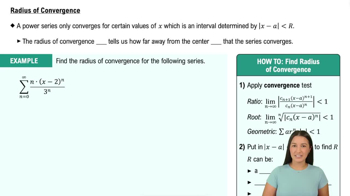
Radius of Convergence
The radius of convergence of a power series is the distance from the center of the series within which the series converges absolutely. It determines the interval on the x-axis where the series represents a valid function. Finding this radius helps understand the domain of convergence for the series.
Recommended video:
Radius of Convergence
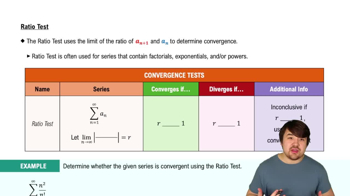
Ratio Test for Convergence
The ratio test is a method to determine the convergence of an infinite series by examining the limit of the absolute value of the ratio of consecutive terms. For power series, it is commonly used to find the radius of convergence by analyzing the limit of |a_{k+1}/a_k| as k approaches infinity.
Recommended video:
Ratio Test
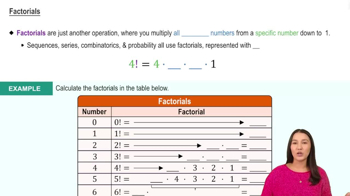
Factorials and Exponential Growth
Factorials (k!) grow faster than exponential functions, which affects the behavior of series terms. Understanding how factorials compare to powers like k^k is crucial when applying convergence tests, as it influences the limit calculations and thus the radius of convergence.
Recommended video:
Factorials
Watch next
Master Intro to Power Series with a bite sized video explanation from Patrick
Start learningRelated Videos
Related Practice
Textbook Question
9
views