In Exercises 1–6, find the domain and range of each function.
G(t) = 2/(t² − 16)
Verified step by step guidance
1
Step 1: Identify the function G(t) = 2/(t² − 16). This is a rational function, which means it is a fraction with a polynomial in the denominator.
Step 2: Determine the domain of the function. The domain consists of all real numbers except those that make the denominator zero. Set the denominator equal to zero: t² − 16 = 0.
Step 3: Solve the equation t² − 16 = 0 to find the values of t that are not in the domain. This can be factored as (t - 4)(t + 4) = 0, giving t = 4 and t = -4.
Step 4: The domain of G(t) is all real numbers except t = 4 and t = -4. In interval notation, this is expressed as (-∞, -4) ∪ (-4, 4) ∪ (4, ∞).
Step 5: Determine the range of the function. Since the function is a rational function and the numerator is a constant, the range is all real numbers except the value that the function approaches as t approaches the values that make the denominator zero. Analyze the behavior of the function as t approaches 4 and -4 to determine the range.
Verified video answer for a similar problem:
This video solution was recommended by our tutors as helpful for the problem above
Video duration:
2m
Play a video:
Was this helpful?
Key Concepts
Here are the essential concepts you must grasp in order to answer the question correctly.
Domain of a Function
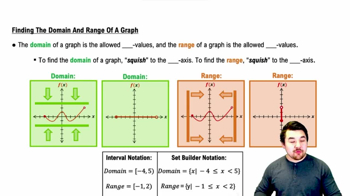
The domain of a function refers to the set of all possible input values (x-values) for which the function is defined. For rational functions like G(t) = 2/(t² − 16), the domain excludes any values that make the denominator zero, as division by zero is undefined. In this case, the domain is all real numbers except for the values that satisfy t² - 16 = 0.
The range of a function is the set of all possible output values (y-values) that the function can produce. For the function G(t) = 2/(t² − 16), the range can be determined by analyzing the behavior of the function as t approaches the values that are excluded from the domain and as t approaches infinity. Understanding the asymptotic behavior helps in identifying the range.
Vertical asymptotes occur in rational functions where the denominator approaches zero, causing the function to approach infinity or negative infinity. For G(t) = 2/(t² − 16), vertical asymptotes exist at the values of t that make the denominator zero, specifically t = 4 and t = -4. These asymptotes indicate where the function is undefined and help in sketching the graph of the function.