
{Use of Tech} Approximating net area The following functions are positive and negative on the given interval. f(𝓍) = x³ on [-1,2] (b) Approximate the net area bounded by the graph of f and the x-axis on the interval using a left, right, and midpoint Riemann sum with n = 4.
Verified step by step guidance
1
Step 1: Understand the problem. You are tasked with approximating the net area bounded by the graph of f(x) = x³ and the x-axis on the interval [-1, 2] using Riemann sums (left, right, and midpoint) with n = 4 subintervals.
Step 2: Divide the interval [-1, 2] into n = 4 equal subintervals. The width of each subinterval, Δx, is calculated as Δx = (b - a) / n, where a = -1 and b = 2. Substitute the values to find Δx.
Step 3: Determine the x-values for the subintervals. For n = 4, the subintervals are [-1, -0.25], [-0.25, 0.5], [0.5, 1.25], and [1.25, 2]. Identify the left endpoints, right endpoints, and midpoints of each subinterval.
Step 4: Compute the Riemann sums. For each type of sum: (a) Left Riemann sum: Evaluate f(x) at the left endpoints of each subinterval and multiply by Δx. (b) Right Riemann sum: Evaluate f(x) at the right endpoints of each subinterval and multiply by Δx. (c) Midpoint Riemann sum: Evaluate f(x) at the midpoints of each subinterval and multiply by Δx.
Step 5: Add the contributions from each subinterval for the left, right, and midpoint Riemann sums. This will give you the approximate net area for each method. Note that the net area accounts for both positive and negative contributions of f(x) over the interval.
Verified video answer for a similar problem:
This video solution was recommended by our tutors as helpful for the problem above
Video duration:
4m
Play a video:
Was this helpful?
Key Concepts
Here are the essential concepts you must grasp in order to answer the question correctly.
Riemann Sums
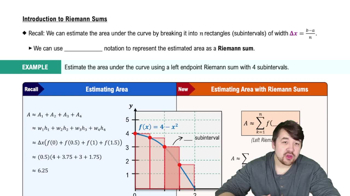
Riemann sums are a method for approximating the total area under a curve by dividing the region into smaller subintervals. Each subinterval's area is estimated using the function's value at specific points, such as the left endpoint, right endpoint, or midpoint. The sum of these areas provides an approximation of the net area between the curve and the x-axis over the specified interval.
The net area refers to the total area between a curve and the x-axis, accounting for both positive and negative areas. When a function is above the x-axis, the area is considered positive, while areas below the x-axis are negative. The net area is calculated by subtracting the negative area from the positive area, providing a comprehensive measure of the total area over the given interval.
Interval division involves breaking down a continuous interval into smaller segments to facilitate calculations, such as Riemann sums. In this case, the interval [-1, 2] is divided into four equal parts, allowing for the evaluation of the function at specific points within each subinterval. This division is crucial for accurately approximating the area under the curve using the chosen Riemann sum method.