
Given the double integral , which of the following represents the correct limits of integration after changing the order of integration?
Table of contents
- 0. Functions7h 54m
- Introduction to Functions16m
- Piecewise Functions10m
- Properties of Functions9m
- Common Functions1h 8m
- Transformations5m
- Combining Functions27m
- Exponent rules32m
- Exponential Functions28m
- Logarithmic Functions24m
- Properties of Logarithms36m
- Exponential & Logarithmic Equations35m
- Introduction to Trigonometric Functions38m
- Graphs of Trigonometric Functions44m
- Trigonometric Identities47m
- Inverse Trigonometric Functions48m
- 1. Limits and Continuity2h 2m
- 2. Intro to Derivatives1h 33m
- 3. Techniques of Differentiation3h 18m
- 4. Applications of Derivatives2h 38m
- 5. Graphical Applications of Derivatives6h 2m
- 6. Derivatives of Inverse, Exponential, & Logarithmic Functions2h 37m
- 7. Antiderivatives & Indefinite Integrals1h 26m
- 8. Definite Integrals4h 44m
- 9. Graphical Applications of Integrals2h 27m
- 10. Physics Applications of Integrals 3h 16m
- 11. Integrals of Inverse, Exponential, & Logarithmic Functions2h 34m
- 12. Techniques of Integration7h 41m
- 13. Intro to Differential Equations2h 55m
- 14. Sequences & Series5h 36m
- 15. Power Series2h 19m
- 16. Parametric Equations & Polar Coordinates7h 58m
1. Limits and Continuity
Introduction to Limits
Problem 9.1.54c
Textbook Question
52-56. In this section, several models are presented and the solution of the associated differential equation is given. Later in the chapter, we present methods for solving these differential equations.
{Use of Tech} Free fall One possible model that describes the free fall of an object in a gravitational field subject to air resistance uses the equation v'(t) = g - bv, where v(t) is the velocity of the object for t ≥ 0, g = 9.8 m/s² is the acceleration due to gravity, and b > 0 is a constant that involves the mass of the object and the air resistance.
c. Using the graph in part (b), estimate the terminal velocity lim(t→∞) v(t).
Verified step by step guidance1
Understand that the terminal velocity is the velocity value that the object approaches as time \(t\) goes to infinity, meaning \(\lim_{t \to \infty} v(t)\).
Recall the given differential equation: \(v'(t) = g - b v(t)\), where \(g\) and \(b\) are constants, and \(v(t)\) is the velocity at time \(t\).
At terminal velocity, the velocity no longer changes, so the derivative \(v'(t)\) becomes zero. Set \(v'(t) = 0\) to find the equilibrium velocity: \$0 = g - b v_{terminal}$.
Solve the equation for \(v_{terminal}\): \(b v_{terminal} = g\), which gives \(v_{terminal} = \frac{g}{b}\).
Use the graph from part (b) to estimate the value that \(v(t)\) approaches as \(t\) becomes very large, and compare it to the theoretical terminal velocity \(\frac{g}{b}\).
Verified video answer for a similar problem:This video solution was recommended by our tutors as helpful for the problem above
Video duration:
2mPlay a video:
Was this helpful?
Key Concepts
Here are the essential concepts you must grasp in order to answer the question correctly.
First-Order Linear Differential Equations
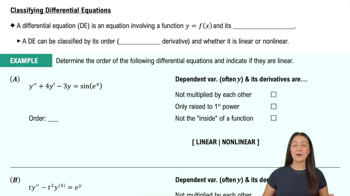
This type of differential equation has the form v'(t) + p(t)v(t) = q(t). In the given model, v'(t) = g - bv can be rewritten as v'(t) + bv = g, which is linear. Understanding how to identify and solve such equations is essential for analyzing velocity over time.
Recommended video:
Classifying Differential Equations
Terminal Velocity
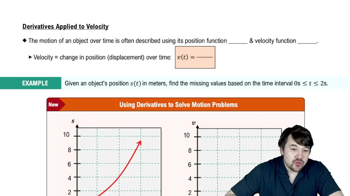
Terminal velocity is the steady-state velocity an object reaches when the net acceleration becomes zero. Mathematically, it is the limit of v(t) as t approaches infinity, where the forces of gravity and air resistance balance out, resulting in constant velocity.
Recommended video:
Derivatives Applied To Velocity
Limit of a Function as t Approaches Infinity
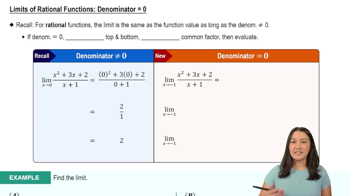
Evaluating lim(t→∞) v(t) involves understanding how the solution to the differential equation behaves over a long time. This concept helps determine the long-term behavior of velocity, such as reaching terminal velocity in free fall with air resistance.
Recommended video:
Limits of Rational Functions: Denominator = 0
Watch next
Master Finding Limits Numerically and Graphically with a bite sized video explanation from Patrick
Start learningRelated Videos
Related Practice
Multiple Choice
17
views
