Use the following facts. If x represents an integer, then x+1 represents the next consecutive integer. If x represents an even integer, then x+2 represents the next consecutive even integer. If x represents an odd integer, then x+2 represents the next consecutive odd integer. Find two consecutive even integers whose product is 224.
Table of contents
- 0. Review of Algebra4h 18m
- 1. Equations & Inequalities3h 18m
- 2. Graphs of Equations1h 43m
- 3. Functions2h 17m
- 4. Polynomial Functions1h 44m
- 5. Rational Functions1h 23m
- 6. Exponential & Logarithmic Functions2h 28m
- 7. Systems of Equations & Matrices4h 5m
- 8. Conic Sections2h 23m
- 9. Sequences, Series, & Induction1h 22m
- 10. Combinatorics & Probability1h 45m
1. Equations & Inequalities
The Square Root Property
Problem 52
Textbook Question
Evaluate the discriminant for each equation. Then use it to determine the number and type of solutions. 16x² +3 = -26x
Verified step by step guidance1
Rewrite the given equation in standard quadratic form \(ax^2 + bx + c = 0\). Start by moving all terms to one side: \$16x^2 + 26x + 3 = 0$.
Identify the coefficients: \(a = 16\), \(b = 26\), and \(c = 3\) from the standard form.
Recall the formula for the discriminant: \(\Delta = b^2 - 4ac\).
Substitute the values of \(a\), \(b\), and \(c\) into the discriminant formula: \(\Delta = (26)^2 - 4 \times 16 \times 3\).
Analyze the value of the discriminant: if \(\Delta > 0\), there are two distinct real solutions; if \(\Delta = 0\), there is exactly one real solution; if \(\Delta < 0\), there are two complex solutions.
Verified video answer for a similar problem:This video solution was recommended by our tutors as helpful for the problem above
Video duration:
1mPlay a video:
Was this helpful?
Key Concepts
Here are the essential concepts you must grasp in order to answer the question correctly.
Quadratic Equation Standard Form
A quadratic equation is typically written as ax² + bx + c = 0, where a, b, and c are constants. To analyze or solve the equation, it must first be rearranged into this standard form by moving all terms to one side.
Recommended video:
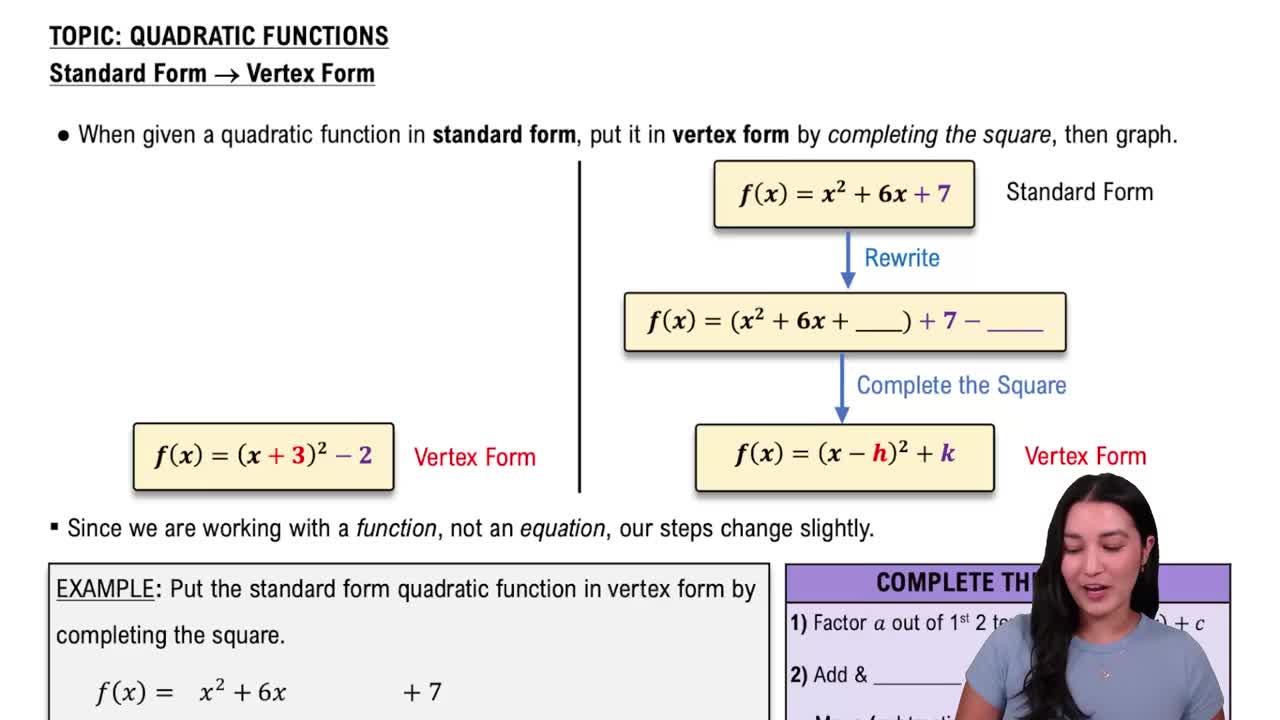
Converting Standard Form to Vertex Form
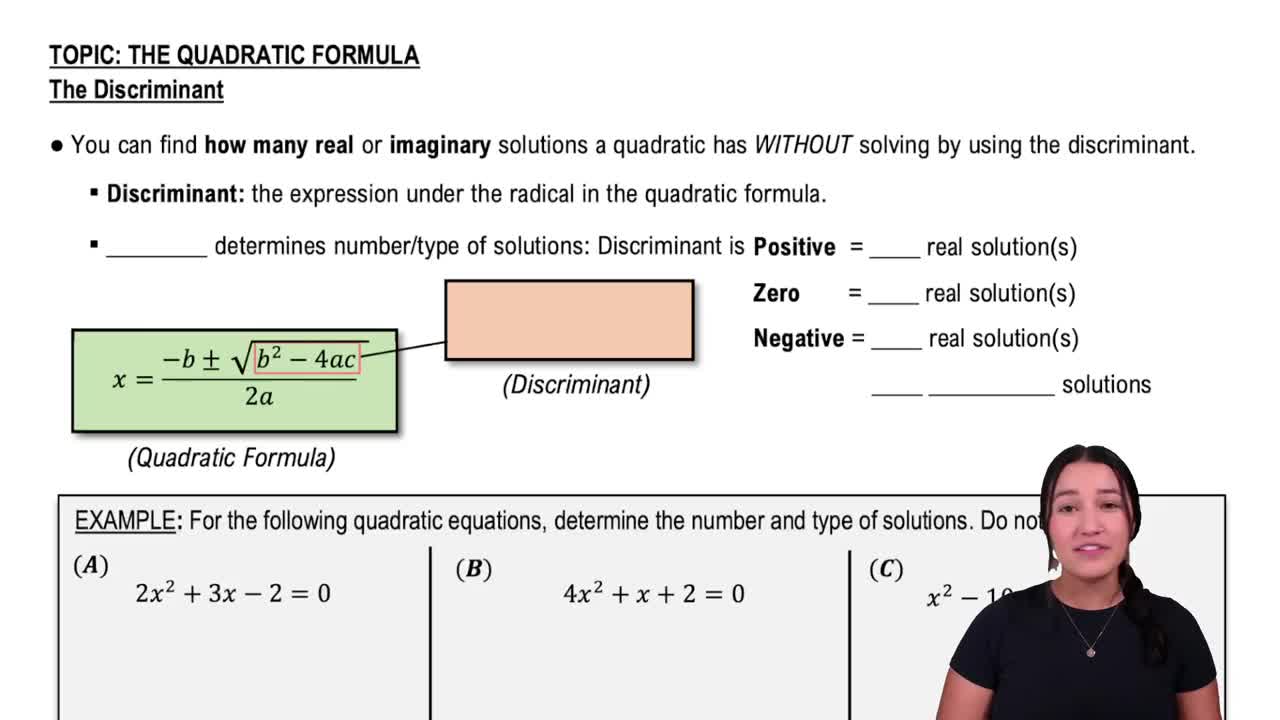
Discriminant of a Quadratic Equation
The discriminant is given by the formula Δ = b² - 4ac. It helps determine the nature of the roots of a quadratic equation without solving it. The value indicates whether the roots are real and distinct, real and equal, or complex.
Recommended video:
The Discriminant
Interpreting the Discriminant to Determine Solutions
If the discriminant is positive, the quadratic has two distinct real solutions; if zero, one real repeated solution; if negative, two complex conjugate solutions. This interpretation guides understanding the number and type of solutions.
Recommended video:
The Discriminant
Watch next
Master Solving Quadratic Equations by the Square Root Property with a bite sized video explanation from Patrick
Start learningRelated Videos
Related Practice
Textbook Question
25
views