Finding Limits In Exercises 9–24, find the limit or explain why it does not exist.
lim x →π cos² (x― tan x)
Verified step by step guidance
1
First, understand the expression for which you need to find the limit: \( \lim_{x \to \pi} \cos^2(x - \tan x) \). This involves the cosine function squared, evaluated at \( x - \tan x \).
Next, evaluate the behavior of \( x - \tan x \) as \( x \) approaches \( \pi \). Since \( \tan x \) is undefined at \( x = \pi \), consider the behavior of \( \tan x \) near \( \pi \).
Recognize that \( \tan x \) approaches 0 as \( x \) approaches \( \pi \) from either side, because \( \tan(\pi) = 0 \). Therefore, \( x - \tan x \) approaches \( \pi \) as \( x \to \pi \).
Substitute the limit of \( x - \tan x \) into the cosine function: \( \cos^2(x - \tan x) \to \cos^2(\pi) \). Recall that \( \cos(\pi) = -1 \), so \( \cos^2(\pi) = (-1)^2 = 1 \).
Conclude that the limit of the original expression is \( 1 \), as the squared cosine of \( \pi \) is \( 1 \). Thus, \( \lim_{x \to \pi} \cos^2(x - \tan x) = 1 \).
Verified video answer for a similar problem:

This video solution was recommended by our tutors as helpful for the problem above
Video duration:
1m
Play a video:
0 Comments
Key Concepts
Here are the essential concepts you must grasp in order to answer the question correctly.
Limits
A limit is a fundamental concept in calculus that describes the behavior of a function as its input approaches a certain value. It helps in understanding the function's value at points where it may not be explicitly defined. For example, limits are essential for evaluating functions at points of discontinuity or for determining the behavior of functions at infinity.
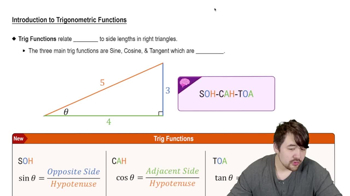
Trigonometric functions, such as cosine and tangent, are periodic functions that relate angles to ratios of sides in right triangles. Understanding these functions is crucial for evaluating limits involving angles, especially when they approach specific values like π. The behavior of these functions near their critical points can significantly affect the limit's outcome.
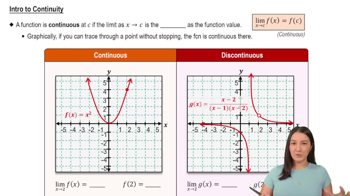
Continuity refers to a property of functions where small changes in the input result in small changes in the output. A function is continuous at a point if the limit as the input approaches that point equals the function's value at that point. This concept is vital when finding limits, as it helps determine whether a limit exists and if it can be evaluated directly.