
Explain why b^x = e^xlnb.
Table of contents
- 0. Functions7h 54m
- Introduction to Functions16m
- Piecewise Functions10m
- Properties of Functions9m
- Common Functions1h 8m
- Transformations5m
- Combining Functions27m
- Exponent rules32m
- Exponential Functions28m
- Logarithmic Functions24m
- Properties of Logarithms36m
- Exponential & Logarithmic Equations35m
- Introduction to Trigonometric Functions38m
- Graphs of Trigonometric Functions44m
- Trigonometric Identities47m
- Inverse Trigonometric Functions48m
- 1. Limits and Continuity2h 2m
- 2. Intro to Derivatives1h 33m
- 3. Techniques of Differentiation3h 18m
- 4. Applications of Derivatives2h 38m
- 5. Graphical Applications of Derivatives6h 2m
- 6. Derivatives of Inverse, Exponential, & Logarithmic Functions2h 37m
- 7. Antiderivatives & Indefinite Integrals1h 26m
- 8. Definite Integrals4h 44m
- 9. Graphical Applications of Integrals2h 27m
- 10. Physics Applications of Integrals 3h 16m
- 11. Integrals of Inverse, Exponential, & Logarithmic Functions2h 34m
- 12. Techniques of Integration7h 41m
- 13. Intro to Differential Equations2h 55m
- 14. Sequences & Series5h 36m
- 15. Power Series2h 19m
- 16. Parametric Equations & Polar Coordinates7h 58m
0. Functions
Exponential & Logarithmic Equations
Problem 7.2.45d
Textbook Question
Chemotherapy In an experimental study at Dartmouth College, mice with tumors were treated with the chemotherapeutic drug Cisplatin. Before treatment, the tumors consisted entirely of clonogenic cells that divide rapidly, causing the tumors to double in size every 2.9 days. Immediately after treatment, 99% of the cells in the tumor became quiescent cells which do not divide and lose 50% of their volume every 5.7 days. For a particular mouse, assume the tumor size is 0.5 cm³ at the time of treatment.
d. Plot a graph of V(t) for 0 ≤ t ≤ 15. What happens to the size of the tumor, assuming there are no follow-up treatments with Cisplatin?
Verified step by step guidance1
Identify the two phases of tumor volume change: before treatment, the tumor doubles every 2.9 days due to rapidly dividing clonogenic cells; after treatment, 99% of cells become quiescent and lose 50% of their volume every 5.7 days.
At time \(t=0\), the tumor volume is \(V(0) = 0.5\) cm³. Immediately after treatment, 1% of the tumor volume continues to grow as before, and 99% becomes quiescent and shrinks over time.
Express the tumor volume \(V(t)\) as the sum of two components for \(t \geq 0\): the growing part and the shrinking part. The growing part is \$0.01 \times 0.5 \times 2^{\frac{t}{2.9}}\(, since it doubles every 2.9 days. The shrinking part is \)0.99 \times 0.5 \times \left(\frac{1}{2}\right)^{\frac{t}{5.7}}$, since it halves every 5.7 days.
Write the full expression for \(V(t)\) as:
\(V(t) = 0.01 \times 0.5 \times 2^{\frac{t}{2.9}} + 0.99 \times 0.5 \times \left(\frac{1}{2}\right)^{\frac{t}{5.7}}\)
To plot \(V(t)\) for \$0 \leq t \leq 15\(, calculate values of \)V(t)$ at various points in this interval using the formula above, then sketch or use graphing software. Observe how the tumor volume changes over time without further treatment.
Verified video answer for a similar problem:This video solution was recommended by our tutors as helpful for the problem above
Video duration:
2mPlay a video:
Was this helpful?
Key Concepts
Here are the essential concepts you must grasp in order to answer the question correctly.
Exponential Growth and Decay
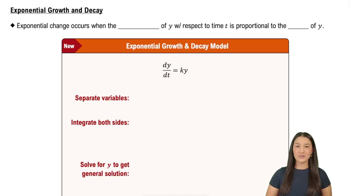
Exponential growth describes processes where quantities increase at rates proportional to their current size, such as tumor cells doubling every fixed time period. Conversely, exponential decay models processes where quantities decrease proportionally over time, like the volume loss of quiescent cells. Understanding these models helps predict tumor size changes over time.
Recommended video:
Exponential Growth & Decay
Clonogenic vs. Quiescent Cells
Clonogenic cells are actively dividing tumor cells responsible for rapid growth, while quiescent cells are non-dividing and metabolically less active, often shrinking over time. Differentiating these cell types is crucial to model tumor dynamics accurately after treatment, as their growth and decay behaviors differ significantly.
Recommended video:
The Power Rule: Negative & Rational Exponents Example 3
Piecewise Function Modeling
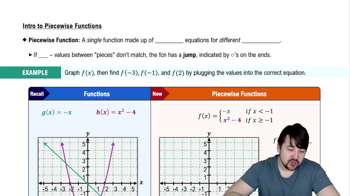
Piecewise functions allow modeling of systems with different behaviors in distinct time intervals or conditions. In this problem, the tumor volume changes due to two cell populations with different growth/decay rates, requiring a combined model that accounts for the initial rapid growth and subsequent decay phases to plot V(t) accurately.
Recommended video:
Piecewise Functions
Watch next
Master Solving Exponential Equations Using Like Bases with a bite sized video explanation from Patrick
Start learningRelated Videos
Related Practice
Textbook Question
917
views
