

First, recognize that the expression inside the derivative is a composition of functions: ln(√(x² + 1)). This can be rewritten using the property of logarithms: ln(√(x² + 1)) = (1/2)ln(x² + 1).
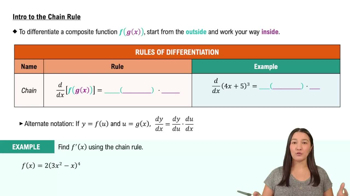
Apply the chain rule for differentiation. The chain rule states that if you have a composite function f(g(x)), the derivative is f'(g(x)) * g'(x). Here, f(u) = (1/2)ln(u) and g(x) = x² + 1.
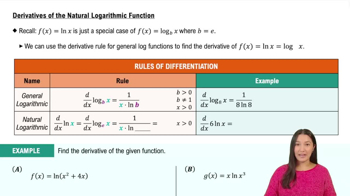
Differentiate the outer function f(u) = (1/2)ln(u) with respect to u. The derivative of ln(u) is 1/u, so f'(u) = (1/2)(1/u) = 1/(2u).
Differentiate the inner function g(x) = x² + 1 with respect to x. The derivative of x² is 2x, and the derivative of a constant is 0, so g'(x) = 2x.
Combine the results using the chain rule: d/dx(ln(√(x² + 1))) = (1/(2(x² + 1))) * (2x). Simplify the expression to get the final derivative.
Verified video answer for a similar problem:
This video solution was recommended by our tutors as helpful for the problem above
Video duration:
7m
Play a video:
0 Comments
Key Concepts
Here are the essential concepts you must grasp in order to answer the question correctly.
Derivative
The derivative of a function measures how the function's output changes as its input changes. It is a fundamental concept in calculus, representing the slope of the tangent line to the curve of the function at any given point. The notation d/dx indicates that we are taking the derivative with respect to the variable x.
The natural logarithm, denoted as ln, is the logarithm to the base e, where e is approximately 2.71828. It is an important function in calculus, particularly in integration and differentiation, as it has unique properties that simplify many calculations. The derivative of ln(u) is 1/u * du/dx, where u is a function of x.
The chain rule is a fundamental technique in calculus used to differentiate composite functions. It states that if a function y is composed of another function u, which in turn is a function of x, then the derivative dy/dx can be found by multiplying the derivative of y with respect to u by the derivative of u with respect to x. This is essential when dealing with functions like ln(√(x² + 1)).