Step 1: Identify the function y = 10^{\sin x} + (\sin x)^{10}. This function is a sum of two terms: 10^{\sin x} and (\sin x)^{10}.
Step 2: Differentiate the first term 10^{\sin x} using the chain rule. The derivative of a^u, where a is a constant and u is a function of x, is a^u \ln(a) \cdot u'. Here, a = 10 and u = \sin x.
Step 3: Differentiate \sin x with respect to x to find u'. The derivative of \sin x is \cos x.
Step 4: Differentiate the second term (\sin x)^{10} using the chain rule. The derivative of u^n, where u is a function of x and n is a constant, is n \cdot u^{n-1} \cdot u'. Here, u = \sin x and n = 10.
Step 5: Combine the derivatives from Steps 2 and 4 to find y'. The derivative of y is the sum of the derivatives of its terms.
Verified video answer for a similar problem:
This video solution was recommended by our tutors as helpful for the problem above
Video duration:
5m
Play a video:
Was this helpful?
Key Concepts
Here are the essential concepts you must grasp in order to answer the question correctly.
Differentiation
Differentiation is the process of finding the derivative of a function, which represents the rate of change of the function with respect to its variable. In this context, we need to apply differentiation rules to the given function y = 10^sin x + sin¹⁰x to find y'.
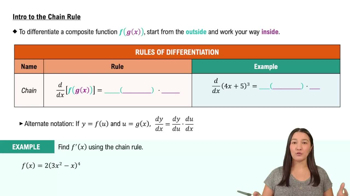
The Chain Rule is a fundamental technique in calculus used to differentiate composite functions. It states that if a function y is composed of another function u, then the derivative of y with respect to x can be found by multiplying the derivative of y with respect to u by the derivative of u with respect to x. This is particularly relevant for terms like 10^sin x.
The Power Rule is a basic rule for differentiation that states if y = x^n, then the derivative y' = n*x^(n-1). This rule will be applied to the term sin¹⁰x, where we treat sin x as a function raised to a power, allowing us to find its derivative effectively.