Ch. 4 - Applications of the Derivative
Briggs - Calculus: Early Transcendentals 3rd Edition
Briggs3rd EditionCalculus: Early TranscendentalsISBN: 9780136847243Not the one you use?Change textbook
Chapter 4, Problem 106

{Use of Tech} Graph carefully Graph the function f(x) = 60x⁵ - 901x³ + 27x in the window [-4,4] x [-10,000, 10,000]. How many extreme values do you see? Locate all the extreme values by analyzing f'. 

Verified step by step guidance
1
First, find the derivative of the function f(x) = 60x⁵ - 901x³ + 27x. This will help us identify the critical points where extreme values might occur. The derivative, f'(x), is calculated using the power rule.
Apply the power rule to each term: for 60x⁵, the derivative is 300x⁴; for -901x³, the derivative is -2703x²; and for 27x, the derivative is 27. Thus, f'(x) = 300x⁴ - 2703x² + 27.
Set the derivative f'(x) equal to zero to find the critical points: 300x⁴ - 2703x² + 27 = 0. Solve this equation for x to find the potential extreme values.
Analyze the critical points found in the previous step by using the second derivative test or by evaluating the sign changes of f'(x) around these points to determine if they correspond to local maxima, minima, or saddle points.
Finally, graph the function f(x) = 60x⁵ - 901x³ + 27x in the specified window [-4,4] x [-10,000, 10,000] to visually confirm the number and location of extreme values. Compare these with the critical points found analytically.

Verified video answer for a similar problem:

This video solution was recommended by our tutors as helpful for the problem above.
Video duration:
7m
Was this helpful?

Key Concepts

Here are the essential concepts you must grasp in order to answer the question correctly.

Graphing Polynomial Functions

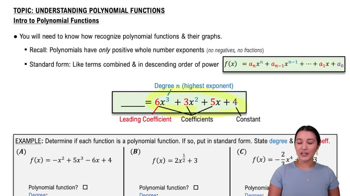
Graphing polynomial functions involves plotting the curve of a polynomial equation, which in this case is f(x) = 60x⁵ - 901x³ + 27x. Understanding the behavior of polynomials, such as end behavior and turning points, is crucial. The degree and leading coefficient of the polynomial help predict the graph's shape and direction.
Recommended video:
6:04
Introduction to Polynomial Functions

Derivative and Critical Points

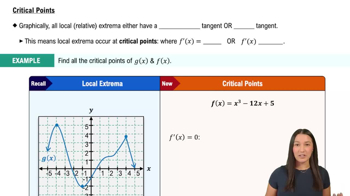
The derivative of a function, denoted as f', provides information about the function's rate of change. Critical points occur where the derivative is zero or undefined, indicating potential extreme values (maxima or minima). Analyzing f' helps locate these points, which are essential for understanding the function's behavior and identifying extreme values.
Recommended video:
04:50
Critical Points

Extreme Values and Their Identification

Extreme values of a function are the highest or lowest points on its graph, known as maxima and minima. These can be local (within a specific interval) or global (overall). By analyzing the critical points found from the derivative, one can determine where these extreme values occur, which is crucial for understanding the function's overall behavior.
Recommended video:
06:37
Average Value of a Function