Which of the following is an antiderivative of with respect to ?
Table of contents
- 0. Functions7h 54m
- Introduction to Functions16m
- Piecewise Functions10m
- Properties of Functions9m
- Common Functions1h 8m
- Transformations5m
- Combining Functions27m
- Exponent rules32m
- Exponential Functions28m
- Logarithmic Functions24m
- Properties of Logarithms36m
- Exponential & Logarithmic Equations35m
- Introduction to Trigonometric Functions38m
- Graphs of Trigonometric Functions44m
- Trigonometric Identities47m
- Inverse Trigonometric Functions48m
- 1. Limits and Continuity2h 2m
- 2. Intro to Derivatives1h 33m
- 3. Techniques of Differentiation3h 18m
- 4. Applications of Derivatives2h 38m
- 5. Graphical Applications of Derivatives6h 2m
- 6. Derivatives of Inverse, Exponential, & Logarithmic Functions2h 37m
- 7. Antiderivatives & Indefinite Integrals1h 26m
- 8. Definite Integrals4h 44m
- 9. Graphical Applications of Integrals2h 27m
- 10. Physics Applications of Integrals 3h 16m
- 11. Integrals of Inverse, Exponential, & Logarithmic Functions2h 34m
- 12. Techniques of Integration7h 41m
- 13. Intro to Differential Equations2h 55m
- 14. Sequences & Series5h 36m
- 15. Power Series2h 19m
- 16. Parametric Equations & Polar Coordinates7h 58m
7. Antiderivatives & Indefinite Integrals
Antiderivatives
Problem 4.9.7
Textbook Question
Give the antiderivatives of 1/x.
Verified step by step guidance1
Recognize that the function 1/x is a standard form for which the antiderivative is well-known. The antiderivative of 1/x is related to the natural logarithm function.
Recall the rule for the antiderivative of 1/x: ∫(1/x) dx = ln|x| + C, where ln|x| represents the natural logarithm of the absolute value of x, and C is the constant of integration.
Understand why the absolute value is necessary: The natural logarithm function, ln(x), is only defined for positive values of x. To account for both positive and negative values of x, we use ln|x|.
Write the general form of the antiderivative: ∫(1/x) dx = ln|x| + C. This represents the family of functions whose derivative is 1/x.
Conclude that the antiderivative of 1/x is ln|x| + C, emphasizing the importance of including the constant of integration (C) to represent all possible antiderivatives.
Verified video answer for a similar problem:This video solution was recommended by our tutors as helpful for the problem above
Video duration:
2mPlay a video:
Was this helpful?
Key Concepts
Here are the essential concepts you must grasp in order to answer the question correctly.
Antiderivative
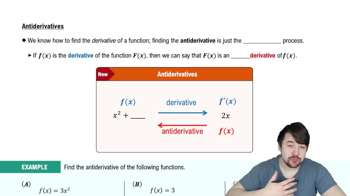
An antiderivative of a function is another function whose derivative is the original function. In calculus, finding the antiderivative is a fundamental operation, often referred to as integration. The process of determining an antiderivative can yield a family of functions differing by a constant, known as the constant of integration.
Recommended video:
Antiderivatives
Natural Logarithm
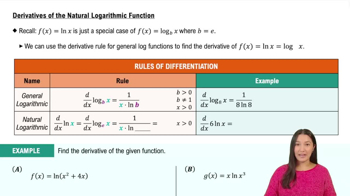
The natural logarithm, denoted as ln(x), is the logarithm to the base e, where e is approximately 2.71828. It is particularly important in calculus because the derivative of ln(x) is 1/x, making it the antiderivative of 1/x. Understanding the properties of logarithms is essential for solving integrals involving exponential functions.
Recommended video:
Derivative of the Natural Logarithmic Function
Integration Constant
When finding antiderivatives, the result includes an integration constant (C) because the derivative of a constant is zero. This means that multiple functions can have the same derivative, differing only by a constant value. Recognizing the importance of this constant is crucial for expressing the general solution to an indefinite integral.
Recommended video:
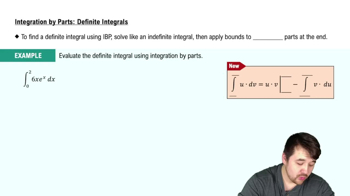
Integration by Parts for Definite Integrals
Related Videos
Related Practice
Multiple Choice
25
views