A general proof of the Chain Rule Let f and g be differentiable functions with h(x)=f(g(x)). For a given constant a, let u=g(a) and v=g(x), and define H (v) = <1x1 matrix> c. Show that h′(a) = lim x→a ((H(g(x))+f′(g(a)))⋅g(x)−g(a)/x−a).
Verified step by step guidance
1
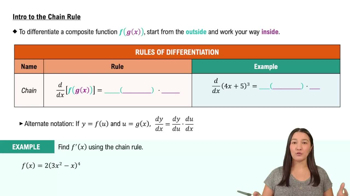
Step 1: Start by understanding the Chain Rule, which states that if you have a composite function h(x) = f(g(x)), then the derivative h'(x) is given by f'(g(x)) * g'(x).
Step 2: Recognize that the problem asks you to show that h'(a) can be expressed as a limit. This involves using the definition of the derivative as a limit: h'(a) = lim (x→a) [(h(x) - h(a)) / (x - a)].
Step 3: Substitute h(x) = f(g(x)) and h(a) = f(g(a)) into the limit definition: h'(a) = lim (x→a) [(f(g(x)) - f(g(a))) / (x - a)].
Step 4: To connect this with the given expression, note that H(v) is a function of v = g(x), and consider the derivative of f at g(a), which is f'(g(a)). This suggests using the limit definition of the derivative for f at g(a): f'(g(a)) = lim (v→u) [(f(v) - f(u)) / (v - u)].
Step 5: Recognize that the expression (H(g(x)) + f'(g(a))) ⋅ (g(x) - g(a)) / (x - a) is a form of the derivative of the composite function, where H(g(x)) represents a term that approaches zero as x approaches a, ensuring the limit evaluates to the derivative h'(a).
Verified video answer for a similar problem:
This video solution was recommended by our tutors as helpful for the problem above
Video duration:
6m
Play a video:
Was this helpful?
Key Concepts
Here are the essential concepts you must grasp in order to answer the question correctly.
Chain Rule
The Chain Rule is a fundamental theorem in calculus that describes how to differentiate composite functions. If you have two functions, f and g, the Chain Rule states that the derivative of the composite function h(x) = f(g(x)) is given by h'(x) = f'(g(x)) * g'(x). This rule is essential for understanding how changes in one variable affect another through a function.
Limits are a core concept in calculus that describe the behavior of a function as its input approaches a certain value. In the context of derivatives, the limit is used to define the derivative itself, as it represents the slope of the tangent line to the function at a specific point. Understanding limits is crucial for proving the Chain Rule and for analyzing the continuity and differentiability of functions.
Differentiability refers to the existence of a derivative at a point in a function. A function is differentiable at a point if it has a defined slope (derivative) at that point, which implies that the function is continuous there. In the context of the Chain Rule, both functions f and g must be differentiable for the rule to apply, ensuring that their derivatives can be multiplied together to find the derivative of the composite function.