
Textbook Question
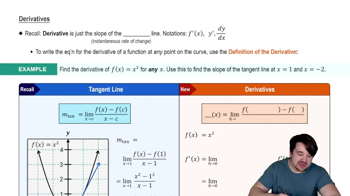
Explain the difference between the average rate of change and the instantaneous rate of change of a function f.
472
views

 Verified step by step guidance
 05:44
05:44
 06:43
06:43 04:50
04:50Explain the difference between the average rate of change and the instantaneous rate of change of a function f.
Use the precise definition of a limit to prove the following limits. Specify a relationship between ε and δ that guarantees the limit exists.
lim x→a (mx+b)=ma+b, for any constants a, b, and m
Derivatives Find the derivative of the following functions. See Example 2 of Section 3.2 for the derivative of √x.
h(t) = t²/2 + 1
The speed of sound (in m/s) in dry air is approximated the function v(T) = 331 + 0.6T, where T is the air temperature (in degrees Celsius). Evaluate v' (T) and interpret its meaning.
Interpreting the derivative Find the derivative of each function at the given point and interpret the physical meaning of this quantity. Include units in your answer.
An object dropped from rest falls d(t)=16t² feet in t seconds. Find d′(4).
Derivatives from graphs Use the figure to find the following derivatives. <IMAGE>
d/dx (xg(x)) | x=2