75–86. Logarithmic differentiation Use logarithmic differentiation to evaluate f'(x). f(x) = (x+1)¹⁰ / (2x-4)⁸
Verified step by step guidance
1
Step 1: Begin by taking the natural logarithm of both sides of the equation y = (x+1)^10 / (2x-4)^8, where y = f(x). This gives us ln(y) = ln((x+1)^10 / (2x-4)^8).
Step 2: Use the properties of logarithms to simplify the expression. The property ln(a/b) = ln(a) - ln(b) and ln(a^b) = b*ln(a) can be applied here. So, ln(y) = 10*ln(x+1) - 8*ln(2x-4).
Step 3: Differentiate both sides of the equation with respect to x. On the left side, use the chain rule: d/dx[ln(y)] = (1/y) * dy/dx. On the right side, differentiate each term separately: d/dx[10*ln(x+1)] = 10/(x+1) and d/dx[-8*ln(2x-4)] = -8*(1/(2x-4))*2.
Step 4: Substitute the derivatives back into the equation from Step 3: (1/y) * dy/dx = 10/(x+1) - 16/(2x-4).
Step 5: Solve for dy/dx by multiplying both sides by y. Since y = (x+1)^10 / (2x-4)^8, substitute this back in to get dy/dx = [(x+1)^10 / (2x-4)^8] * [10/(x+1) - 16/(2x-4)]. This expression represents f'(x).
Verified video answer for a similar problem:
This video solution was recommended by our tutors as helpful for the problem above
Video duration:
8m
Play a video:
Was this helpful?
Key Concepts
Here are the essential concepts you must grasp in order to answer the question correctly.
Logarithmic Differentiation
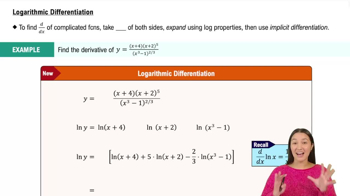
Logarithmic differentiation is a technique used to differentiate functions that are products or quotients of variables raised to powers. By taking the natural logarithm of both sides of the function, we can simplify the differentiation process, especially when dealing with complex expressions. This method transforms products into sums and powers into products, making it easier to apply the rules of differentiation.
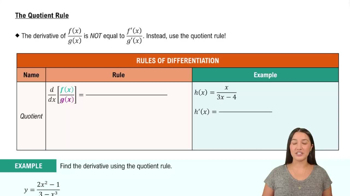
The product rule and quotient rule are fundamental rules in calculus for differentiating products and quotients of functions, respectively. The product rule states that the derivative of a product of two functions is the first function times the derivative of the second plus the second function times the derivative of the first. The quotient rule, on the other hand, provides a formula for differentiating a quotient, ensuring that the derivative accounts for both the numerator and denominator.
The chain rule is a crucial differentiation rule used when dealing with composite functions, where one function is nested inside another. It states that the derivative of a composite function is the derivative of the outer function evaluated at the inner function, multiplied by the derivative of the inner function. This rule is essential for correctly applying differentiation to functions that involve powers, such as in the given function f(x).