
If F(x) = x² - 3x + C and F (-1) = 4 , what is the value of C?
Verified step by step guidance
1
Start with the given function F(x) = x² - 3x + C, where C is a constant to be determined.
Substitute x = -1 into the function F(x) since it is given that F(-1) = 4. This gives the equation: F(-1) = (-1)² - 3(-1) + C.
Simplify the terms in the equation: (-1)² = 1, -3(-1) = 3, so the equation becomes F(-1) = 1 + 3 + C.
Set F(-1) equal to 4 as given in the problem: 4 = 1 + 3 + C.
Solve for C by isolating it: Subtract 1 and 3 from both sides of the equation to find the value of C.
Verified video answer for a similar problem:
This video solution was recommended by our tutors as helpful for the problem above
Video duration:
1m
Play a video:
Was this helpful?
Key Concepts
Here are the essential concepts you must grasp in order to answer the question correctly.
Function Evaluation
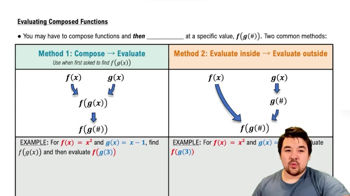
Function evaluation involves substituting a specific input value into a function to determine its output. In this case, we need to evaluate the function F(x) at x = -1 to find the corresponding output, which is given as 4. This process is fundamental in calculus as it allows us to analyze the behavior of functions at specific points.
Algebraic manipulation refers to the techniques used to rearrange and simplify algebraic expressions. To find the value of C in the equation F(-1) = 4, we will substitute -1 into the function F(x) and solve for C. Mastery of algebraic manipulation is essential for solving equations and understanding calculus concepts.
In the context of functions, a constant term is a fixed value that does not change with the input variable. In the function F(x) = x² - 3x + C, the term C represents a constant that shifts the graph of the function vertically. Understanding how constant terms affect function values is crucial for analyzing and interpreting functions in calculus.