7–28. Derivatives Evaluate the following derivatives.
d/dx (sin (ln x))
Verified step by step guidance
1
Step 1: Recognize that the given function is a composition of two functions: the natural logarithm function (ln x) and the sine function (sin u). This requires the use of the chain rule for differentiation.
Step 2: Recall the chain rule: If y = f(g(x)), then dy/dx = f'(g(x)) * g'(x). Here, f(u) = sin(u) and g(x) = ln(x).
Step 3: Differentiate the outer function f(u) = sin(u) with respect to u. The derivative of sin(u) is cos(u). So, f'(u) = cos(u).
Step 4: Differentiate the inner function g(x) = ln(x) with respect to x. The derivative of ln(x) is 1/x. So, g'(x) = 1/x.
Step 5: Combine the results using the chain rule: d/dx [sin(ln(x))] = cos(ln(x)) * (1/x).
Verified video answer for a similar problem:
This video solution was recommended by our tutors as helpful for the problem above
Video duration:
2m
Play a video:
Was this helpful?
Key Concepts
Here are the essential concepts you must grasp in order to answer the question correctly.
Chain Rule
The Chain Rule is a fundamental principle in calculus used to differentiate composite functions. It states that if a function y is composed of two functions u and x, then the derivative of y with respect to x is the derivative of y with respect to u multiplied by the derivative of u with respect to x. This rule is essential for evaluating derivatives of functions like sin(ln x), where ln x is nested within the sine function.
The derivatives of trigonometric functions are key components in calculus. For instance, the derivative of sin(u) with respect to u is cos(u). Understanding these derivatives is crucial when applying the Chain Rule, as it allows us to differentiate functions that involve trigonometric expressions, such as sin(ln x).
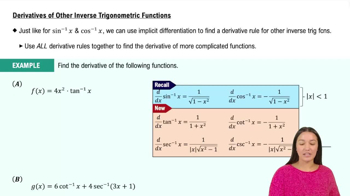
Derivatives of Other Inverse Trigonometric Functions
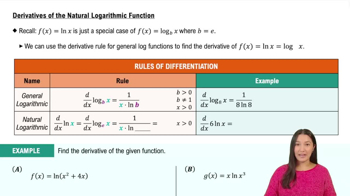
Natural Logarithm Derivative
The natural logarithm function, denoted as ln(x), has a specific derivative: d/dx(ln x) = 1/x. This property is vital when differentiating functions that include the natural logarithm, as it simplifies the process of finding the overall derivative. In the context of the given problem, recognizing this derivative is necessary for applying the Chain Rule effectively.