
Recognize that the equation \( \theta = \frac{\pi}{3} \) represents a line in polar coordinates where the angle \( \theta \) is constant at \( \frac{\pi}{3} \).
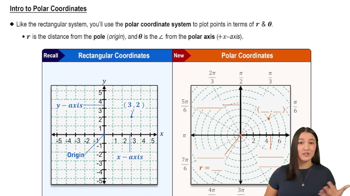
Recall that in polar coordinates, \( \theta \) is the angle measured from the positive x-axis, so the line \( \theta = \frac{\pi}{3} \) is a straight line passing through the origin making an angle of \( \frac{\pi}{3} \) with the x-axis.
To find the slope of this line in Cartesian coordinates, use the relationship between slope \( m \) and angle \( \theta \): \[ m = \tan(\theta) \].
Substitute \( \theta = \frac{\pi}{3} \) into the formula to express the slope as \( m = \tan\left(\frac{\pi}{3}\right) \).
This expression gives the slope of the line \( \theta = \frac{\pi}{3} \) in Cartesian coordinates.
Verified video answer for a similar problem:
This video solution was recommended by our tutors as helpful for the problem above
Video duration:
1m
Play a video:
Was this helpful?
Key Concepts
Here are the essential concepts you must grasp in order to answer the question correctly.
Polar Coordinates and Lines
In polar coordinates, a line defined by θ = constant represents all points making a fixed angle θ with the positive x-axis. This line passes through the origin and extends outward at that angle, differing from the Cartesian form y = mx + b.
The slope of a line in Cartesian coordinates is the tangent of the angle it makes with the positive x-axis. Thus, for a line at angle θ, the slope m = tan(θ), linking angular direction to the line's steepness.
To find the slope of the line θ = π/3, compute m = tan(π/3). Since tan(π/3) = √3, the slope of the line is √3, indicating a steep positive incline in the Cartesian plane.