
49–52. Cartesian-to-polar coordinates Convert the following equations to polar coordinates.
(x - 1)² + y² = 1
Verified step by step guidance
1
Recall the relationships between Cartesian coordinates \((x, y)\) and polar coordinates \((r, \theta)\): \(x = r \cos{\theta}\) and \(y = r \sin{\theta}\).
Substitute \(x = r \cos{\theta}\) and \(y = r \sin{\theta}\) into the given equation \((x - 1)^2 + y^2 = 1\) to rewrite it in terms of \(r\) and \(\theta\).
Simplify the equation by expanding the square and combining like terms: \((r^2 \cos^2{\theta} - 2r \cos{\theta} + 1) + r^2 \sin^2{\theta} = 1\).
Use the Pythagorean identity \(\cos^2{\theta} + \sin^2{\theta} = 1\) to combine terms and then isolate \(r\) to express the equation purely in terms of \(r\) and \(\theta\).
Verified video answer for a similar problem:
This video solution was recommended by our tutors as helpful for the problem above
Video duration:
3m
Play a video:
Was this helpful?
Key Concepts
Here are the essential concepts you must grasp in order to answer the question correctly.
Polar Coordinates System
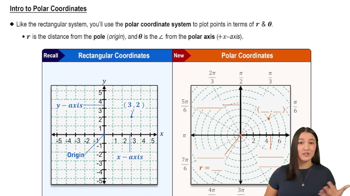
Polar coordinates represent points in the plane using a radius and an angle, denoted as (r, θ), where r is the distance from the origin and θ is the angle from the positive x-axis. This system is useful for describing curves that are circular or have rotational symmetry.
Conversion Formulas Between Cartesian and Polar Coordinates
To convert from Cartesian (x, y) to polar (r, θ), use x = r cos θ and y = r sin θ. Conversely, r = √(x² + y²) and θ = arctan(y/x). These formulas allow rewriting equations from Cartesian form into polar form.
A circle centered at (a, 0) with radius R in Cartesian coordinates can be expressed in polar form by substituting x = r cos θ and y = r sin θ into the circle's equation. This often results in an equation involving r and θ that describes the same circle in polar terms.