

23–51. Calculating derivatives Find the derivative of the following functions. y = tan x + cot x
Verified step by step guidance
1
Step 1: Identify the functions involved in the expression. The given function is \( y = \tan x + \cot x \). Here, \( \tan x \) and \( \cot x \) are trigonometric functions.
Step 2: Recall the derivatives of the basic trigonometric functions. The derivative of \( \tan x \) is \( \sec^2 x \), and the derivative of \( \cot x \) is \( -\csc^2 x \).
Step 3: Apply the sum rule for derivatives. The sum rule states that the derivative of a sum of functions is the sum of their derivatives. Therefore, \( \frac{d}{dx}(\tan x + \cot x) = \frac{d}{dx}(\tan x) + \frac{d}{dx}(\cot x) \).
Step 4: Substitute the derivatives of the individual functions into the expression. This gives \( \sec^2 x - \csc^2 x \).
Step 5: Simplify the expression if possible. In this case, the expression \( \sec^2 x - \csc^2 x \) is already in its simplest form.
Verified video answer for a similar problem:
This video solution was recommended by our tutors as helpful for the problem above
Video duration:
1m
Play a video:
Was this helpful?
Key Concepts
Here are the essential concepts you must grasp in order to answer the question correctly.
Derivatives
A derivative represents the rate at which a function changes at any given point. It is a fundamental concept in calculus that measures how a function's output value changes as its input value changes. The derivative can be interpreted as the slope of the tangent line to the curve of the function at a specific point.
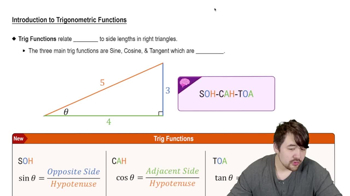
Trigonometric functions, such as sine, cosine, tangent, cotangent, secant, and cosecant, are functions of an angle that relate the angles of a triangle to the lengths of its sides. In calculus, understanding the derivatives of these functions is crucial, as they often appear in various mathematical models and applications.
Derivative rules, such as the sum rule, product rule, and quotient rule, provide systematic methods for finding the derivatives of complex functions. The sum rule states that the derivative of a sum of functions is the sum of their derivatives, which is particularly useful when differentiating functions like y = tan x + cot x.