Ch. 8 - Integration Techniques
Briggs - Calculus: Early Transcendentals 3rd Edition
Briggs3rd EditionCalculus: Early TranscendentalsISBN: 9780136847243Not the one you use?Change textbook
Chapter 8, Problem 8.6.62

7–84. Evaluate the following integrals.
62. ∫ from 0 to π/2 √(1 + cosθ) dθ

Verified step by step guidance
1
Step 1: Recognize that the integral involves a square root and a trigonometric function. To simplify √(1 + cosθ), use the trigonometric identity 1 + cosθ = 2cos²(θ/2). This substitution will simplify the square root.
Step 2: Substitute 1 + cosθ with 2cos²(θ/2). The integral becomes ∫ from 0 to π/2 √(2cos²(θ/2)) dθ, which simplifies further to ∫ from 0 to π/2 √2 * |cos(θ/2)| dθ.
Step 3: Since θ ranges from 0 to π/2, cos(θ/2) is non-negative, so |cos(θ/2)| = cos(θ/2). The integral now becomes ∫ from 0 to π/2 √2 * cos(θ/2) dθ.
Step 4: Perform a substitution to simplify the integral further. Let u = θ/2, which implies du = (1/2)dθ. Adjust the limits of integration: when θ = 0, u = 0; when θ = π/2, u = π/4. The integral becomes ∫ from 0 to π/4 √2 * cos(u) * 2 du.
Step 5: Simplify the integral to ∫ from 0 to π/4 2√2 * cos(u) du. Now, integrate cos(u) with respect to u, which results in sin(u). Substitute the limits of integration to evaluate the result.

Verified video answer for a similar problem:

This video solution was recommended by our tutors as helpful for the problem above.
Video duration:
6m
Was this helpful?

Key Concepts

Here are the essential concepts you must grasp in order to answer the question correctly.

Definite Integral

A definite integral represents the signed area under a curve between two specified limits. In this case, the integral from 0 to π/2 indicates that we are calculating the area under the curve of the function √(1 + cosθ) from θ = 0 to θ = π/2. Understanding the properties of definite integrals, such as the Fundamental Theorem of Calculus, is essential for evaluating them.
Recommended video:
05:43
Definition of the Definite Integral

Trigonometric Identities

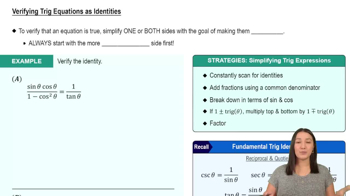
Trigonometric identities are equations involving trigonometric functions that hold true for all values of the variables. In this integral, the expression √(1 + cosθ) can be simplified using the half-angle identity, which states that 1 + cosθ = 2cos²(θ/2). Recognizing and applying these identities can simplify the integration process significantly.
Recommended video:
7:17
Verifying Trig Equations as Identities

Substitution Method

The substitution method is a technique used in integration to simplify the integrand by changing variables. For the integral ∫ √(1 + cosθ) dθ, substituting θ/2 can transform the integral into a more manageable form. This method is particularly useful when dealing with complex expressions, allowing for easier evaluation of the integral.
Recommended video:
07:33
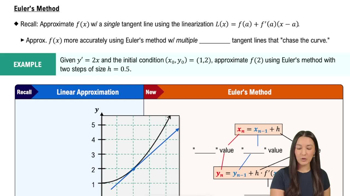
Euler's Method
Related Practice
Textbook Question

{Use of Tech} Using the integral of sec³u By reduction formula 4 in Section 8.3,

∫sec³u du = 1/2 (sec u tan u + ln |sec u + tan u|) + C


Graph the following functions and find the area under the curve on the given interval.

f(x) = (9 - x²) ⁻², [0, 3/2]

55
views
Textbook Question

102–106. Laplace transforms A powerful tool in solving problems in engineering and physics is the Laplace transform. Given a function f(t), the Laplace transform is a new function F(s) defined by F(s) = ∫[0 to ∞] e^(-st) f(t) dt, where we assume s is a positive real number. For example, to find the Laplace transform of f(t) = e^(-t), the following improper integral is evaluated using integration by parts:

F(s) = ∫[0 to ∞] e^(-st) e^(-t) dt = ∫[0 to ∞] e^(-(s+1)t) dt = 1/(s+1).

Verify the following Laplace transforms, where a is a real number.

106. f(t) = cos(at) → F(s) = s/(s² + a²)

47
views
Textbook Question

87-92. An integrand with trigonometric functions in the numerator and denominator can often be converted to a rational function using the substitution u = tan(x/2) or, equivalently, x = 2 tan⁻¹u. The following relations are used in making this change of variables.

A: dx = 2/(1 + u²) du

B: sin x = 2u/(1 + u²)

C: cos x = (1 - u²)/(1 + u²)

88. Evaluate ∫ dx/(2 + cos x).

88
views
Textbook Question

9–61. Trigonometric integrals Evaluate the following integrals.

38. ∫ tan⁵θ sec⁴θ dθ

57
views
Textbook Question

79–82. {Use of Tech} Double table look-up The following integrals may require more than one table look-up. Evaluate the integrals using a table of integrals, and then check your answer with a computer algebra system.

82. ∫ (sin⁻¹(ax)) / x² dx, a > 0

40
views
Textbook Question

7–58. Improper integrals Evaluate the following integrals or state that they diverge.

42. ∫ (from 3 to 4) 1/(x-3)³ᐟ² dx

58
views