Explain why or why not Determine whether the following statements are true and give an explanation or counterexample. c. The polar coordinates (3, -3π/4) and (-3, π/4) describe the same point in the plane.
Verified step by step guidance
1
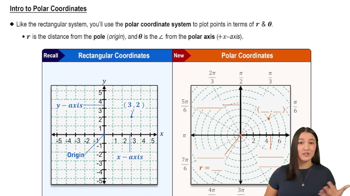
Recall that polar coordinates are given as \((r, \theta)\), where \(r\) is the radius (distance from the origin) and \(\theta\) is the angle measured from the positive x-axis.
Understand that the point described by polar coordinates \((r, \theta)\) can also be represented by \((-r, \theta + \pi)\) because moving in the opposite direction by \(\pi\) radians with a negative radius points to the same location.
Check the given coordinates: \((3, -\frac{3\pi}{4})\) and \((-3, \frac{\pi}{4})\). Notice that the second point has a negative radius and an angle \(\frac{\pi}{4}\).
Add \(\pi\) to the angle of the second point to see if it matches the first point's angle: \(\frac{\pi}{4} + \pi = \frac{5\pi}{4}\). Since \(-\frac{3\pi}{4}\) is coterminal with \(\frac{5\pi}{4}\) (they differ by \$2\pi$), the angles correspond to the same direction.
Conclude that because \((-3, \frac{\pi}{4})\) is equivalent to \((3, \frac{5\pi}{4})\), which is coterminal with \((3, -\frac{3\pi}{4})\), both coordinates describe the same point in the plane.
Verified video answer for a similar problem:
This video solution was recommended by our tutors as helpful for the problem above
Video duration:
3m
Play a video:
Was this helpful?
Key Concepts
Here are the essential concepts you must grasp in order to answer the question correctly.
Polar Coordinates and Their Representation
Polar coordinates represent points in the plane using a radius and an angle, written as (r, θ). The radius r is the distance from the origin, and θ is the angle measured from the positive x-axis. Points can have multiple polar representations due to angle periodicity and sign changes in r.
Equivalence of Polar Coordinates with Negative Radius
A point with coordinates (r, θ) is equivalent to (-r, θ + π) because a negative radius means moving in the opposite direction along the line defined by θ. This property allows different pairs of (r, θ) to represent the same point by adjusting the angle by π when the radius is negative.
Angles in polar coordinates are periodic with period 2π, meaning θ and θ + 2kπ (for any integer k) represent the same direction. This periodicity allows angles outside the standard interval [0, 2π) or (-π, π] to still describe the same point, which is important when comparing coordinates with angles like -3π/4 and π/4.