Use shifts and scalings to transform the graph of into the graph of g. Use a graphing utility to check your work.
Verified step by step guidance
1
Start with the function \( f(x) = \sqrt{x} \).
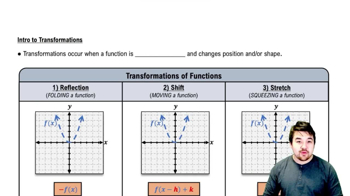
Identify the transformation inside the function: \( f(2x - 1) \). This involves a horizontal scaling and a horizontal shift.
The expression \( 2x - 1 \) indicates a horizontal compression by a factor of \( \frac{1}{2} \) and a shift to the right by \( \frac{1}{2} \).
Apply the vertical transformation: Multiply the function by 2, resulting in \( 2f(2x - 1) \), which vertically stretches the graph by a factor of 2.
Combine these transformations to obtain \( g(x) = 2\sqrt{2x - 1} \). Use a graphing utility to verify the transformations visually.
Verified video answer for a similar problem:
This video solution was recommended by our tutors as helpful for the problem above
Video duration:
7m
Play a video:
Was this helpful?
Key Concepts
Here are the essential concepts you must grasp in order to answer the question correctly.
Function Transformation
Function transformation involves altering the graph of a function through shifts, stretches, and reflections. In this context, the function ƒ(x) = √x is transformed into g(x) = 2ƒ(2x - 1) by applying specific operations. Understanding how these transformations affect the graph's position and shape is crucial for accurately sketching the new function.
Horizontal and vertical shifts are specific types of transformations that move the graph of a function without changing its shape. A horizontal shift occurs when the input variable x is adjusted, while a vertical shift involves scaling the output. In the given function g(x), the term (2x - 1) indicates a horizontal shift to the right by 0.5 units, while the multiplication by 2 scales the output vertically.
Graphing utilities are tools that allow users to visualize mathematical functions and their transformations. These tools can plot graphs based on equations, helping to verify the accuracy of transformations performed manually. In this question, using a graphing utility to check the transformation from ƒ(x) to g(x) provides a visual confirmation of the changes made to the original function.