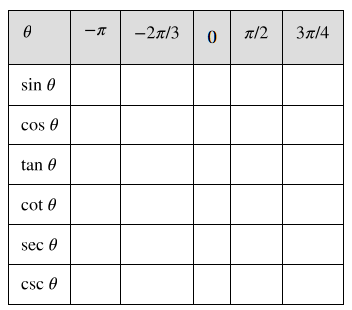
Copy and complete the following table of function values. If the function is undefined at a given angle, enter “UND.” Do not use a calculator or tables.
Verified step by step guidance
1
Identify the function given in the problem. Common trigonometric functions include sine, cosine, tangent, etc. Determine which function you are working with.
Understand the angles provided in the table. These angles are typically standard angles in trigonometry, such as 0°, 30°, 45°, 60°, 90°, etc.
Recall the values of the trigonometric function for these standard angles. For example, \( \sin(0^\circ) = 0 \), \( \sin(30^\circ) = \frac{1}{2} \), \( \sin(45^\circ) = \frac{\sqrt{2}}{2} \), \( \sin(60^\circ) = \frac{\sqrt{3}}{2} \), \( \sin(90^\circ) = 1 \).
Determine if the function is undefined at any of the given angles. For instance, the tangent function is undefined at 90° and 270° because it involves division by zero.
Fill in the table with the corresponding values for each angle, using 'UND' for any undefined values. Ensure each entry is based on the standard trigonometric values and the function's properties.
Verified video answer for a similar problem:
This video solution was recommended by our tutors as helpful for the problem above
Video duration:
7m
Play a video:
0 Comments
Key Concepts
Here are the essential concepts you must grasp in order to answer the question correctly.
Function Values
Function values represent the output of a function for a given input. In trigonometry, these values correspond to specific angles and can include sine, cosine, and tangent functions. Understanding how to evaluate these functions at various angles is crucial for completing the table accurately.
A function is considered undefined at certain points where it does not produce a valid output. For example, the tangent function is undefined at angles where the cosine is zero, leading to division by zero. Recognizing these points is essential for correctly filling in the table with 'UND' where applicable.
Trigonometric identities are equations that relate the angles and ratios of the sine, cosine, and tangent functions. Familiarity with these identities, such as the Pythagorean identity or angle sum formulas, can help simplify calculations and verify function values without the use of calculators or tables.