Which of the following equations represents the orthogonal trajectories of the family of curves given by ?
Table of contents
- 0. Functions7h 55m
- Introduction to Functions18m
- Piecewise Functions10m
- Properties of Functions9m
- Common Functions1h 8m
- Transformations5m
- Combining Functions27m
- Exponent rules32m
- Exponential Functions28m
- Logarithmic Functions24m
- Properties of Logarithms36m
- Exponential & Logarithmic Equations35m
- Introduction to Trigonometric Functions38m
- Graphs of Trigonometric Functions44m
- Trigonometric Identities47m
- Inverse Trigonometric Functions48m
- 1. Limits and Continuity2h 2m
- 2. Intro to Derivatives1h 33m
- 3. Techniques of Differentiation3h 18m
- 4. Applications of Derivatives2h 38m
- 5. Graphical Applications of Derivatives6h 2m
- 6. Derivatives of Inverse, Exponential, & Logarithmic Functions2h 37m
- 7. Antiderivatives & Indefinite Integrals1h 26m
- 8. Definite Integrals4h 44m
- 9. Graphical Applications of Integrals2h 27m
- 10. Physics Applications of Integrals 3h 16m
- 11. Integrals of Inverse, Exponential, & Logarithmic Functions2h 31m
- 12. Techniques of Integration7h 41m
- 13. Intro to Differential Equations2h 55m
- 14. Sequences & Series5h 36m
- 15. Power Series2h 19m
- 16. Parametric Equations & Polar Coordinates7h 58m
2. Intro to Derivatives
Differentiability
Multiple Choice
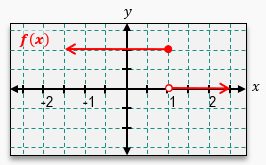
Determine if the graph of the function f(x)is continuous and/or differentiable at x=1.

A
Continuous and non-differentiable
B
Continuous and differentiable
C
Discontinuous and non-differentiable
D
Discontinuous and differentiable
0 Comments
Verified step by step guidance1
Examine the graph of the function f(x) at x=1. Notice that there is a jump discontinuity at this point, as the left-hand limit and the right-hand limit do not match.
To determine continuity at x=1, check if the left-hand limit, right-hand limit, and the value of the function at x=1 are equal. In this case, they are not, indicating the function is discontinuous at x=1.
For differentiability, a function must be continuous at the point in question. Since f(x) is not continuous at x=1, it cannot be differentiable there.
Additionally, even if the function were continuous, the presence of a sharp corner or cusp at x=1 would also prevent differentiability.
Conclude that the function f(x) is both discontinuous and non-differentiable at x=1.
Related Videos
Related Practice
Multiple Choice
122
views