Ch. 10 - Sequences and Infinite Series
Briggs - Calculus: Early Transcendentals 3rd Edition
Briggs3rd EditionCalculus: Early TranscendentalsISBN: 9780136847243Not the one you use?Change textbook
Chapter 10, Problem 10.1.2

Suppose the sequence { aₙ} is defined by the explicit formula aₙ = 1/n, for n=1, 2, 3, .....Write out the first five terms of the sequence.

Verified step by step guidance
1
Identify the given explicit formula for the sequence: \(a_n = \frac{1}{n}\), where \(n = 1, 2, 3, \ldots\).
Understand that to find the first five terms, you substitute \(n = 1, 2, 3, 4, 5\) into the formula.
Calculate the first term by substituting \(n=1\): \(a_1 = \frac{1}{1}\).
Calculate the second term by substituting \(n=2\): \(a_2 = \frac{1}{2}\).
Continue this process for \(n=3, 4, 5\) to find \(a_3 = \frac{1}{3}\), \(a_4 = \frac{1}{4}\), and \(a_5 = \frac{1}{5}\).

Verified video answer for a similar problem:

This video solution was recommended by our tutors as helpful for the problem above.
Video duration:
2m
Was this helpful?

Key Concepts

Here are the essential concepts you must grasp in order to answer the question correctly.

Sequence Definition

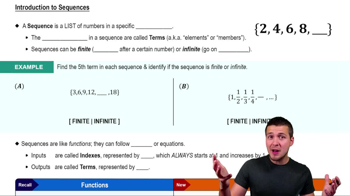
A sequence is an ordered list of numbers defined by a specific rule or formula. Each term in the sequence is identified by its position, usually denoted by n. Understanding how to interpret the formula for aₙ allows you to find any term in the sequence.
Recommended video:
Guided course
8:22
Introduction to Sequences

Explicit Formula for Sequences

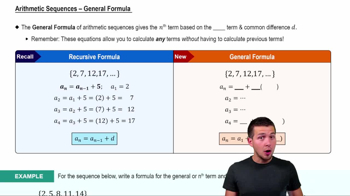
An explicit formula directly expresses the nth term of a sequence as a function of n. For example, aₙ = 1/n means the term at position n is the reciprocal of n. This formula helps compute terms without needing previous terms.
Recommended video:
Guided course
5:17
Arithmetic Sequences - General Formula

Evaluating Terms of a Sequence

To find specific terms, substitute the term number n into the explicit formula. For aₙ = 1/n, the first five terms are found by plugging in n = 1, 2, 3, 4, and 5, resulting in 1, 1/2, 1/3, 1/4, and 1/5 respectively.
Recommended video:
Guided course
8:22
Introduction to Sequences
Related Practice
Textbook Question

9–36. Comparison tests Use the Comparison Test or the Limit Comparison Test to determine whether the following series converge.


∑ (k = 1 to ∞) (k² − 1) / (k³ + 4)

51
views

Textbook Question

11–86. Applying convergence tests Determine whether the following series converge. Justify your answers.


∑ (from k = 1 to ∞)(cos(1 / k) – cos(1 / (k + 1)))

38
views
Textbook Question

43–44. Periodic doses

Suppose you take a dose of m mg of a particular medication once per day. Assume f equals the fraction of the medication that remains in your blood one day later. Just after taking another dose of medication on the second day, the amount of medication in your blood equals the sum of the second dose and the fraction of the first dose remaining in your blood, which is m + mf. Continuing in this fashion, the amount of medication in your blood just after your nth dose is


Aₙ = m + mf + ⋯ + mfⁿ⁻¹.


For the given values of f and m, calculate A₅, A₁₀, A₃₀, and lim (n → ∞) Aₙ. Interpret the meaning of the limit lim (n → ∞) Aₙ.


43.f = 0.25,m = 200 mg

47
views
Textbook Question

9–30. The Ratio and Root Tests Use the Ratio Test or the Root Test to determine whether the following series converge absolutely or diverge.

∑ (from k = 1 to ∞) ((-7)ᵏ / k²)

70
views
Textbook Question

72–86. Evaluating series Evaluate each series or state that it diverges.

∑ (k = 1 to ∞) ((1/3) × (5/6)ᵏ + (3/5) × (7/9)ᵏ)

53
views
Textbook Question

9–30. The Ratio and Root Tests Use the Ratio Test or the Root Test to determine whether the following series converge absolutely or diverge.

∑ (from k = 1 to ∞) ((-1)ᵏ⁺¹ × k²ᵏ) / (k! × k!)

58
views