Find the general formula for the arithmetic sequence below. Without using a recursive formula, calculate the term.
Table of contents
- 0. Functions7h 54m
- Introduction to Functions16m
- Piecewise Functions10m
- Properties of Functions9m
- Common Functions1h 8m
- Transformations5m
- Combining Functions27m
- Exponent rules32m
- Exponential Functions28m
- Logarithmic Functions24m
- Properties of Logarithms36m
- Exponential & Logarithmic Equations35m
- Introduction to Trigonometric Functions38m
- Graphs of Trigonometric Functions44m
- Trigonometric Identities47m
- Inverse Trigonometric Functions48m
- 1. Limits and Continuity2h 2m
- 2. Intro to Derivatives1h 33m
- 3. Techniques of Differentiation3h 18m
- 4. Applications of Derivatives2h 38m
- 5. Graphical Applications of Derivatives6h 2m
- 6. Derivatives of Inverse, Exponential, & Logarithmic Functions2h 37m
- 7. Antiderivatives & Indefinite Integrals1h 26m
- 8. Definite Integrals4h 44m
- 9. Graphical Applications of Integrals2h 27m
- 10. Physics Applications of Integrals 3h 16m
- 11. Integrals of Inverse, Exponential, & Logarithmic Functions2h 34m
- 12. Techniques of Integration7h 41m
- 13. Intro to Differential Equations2h 55m
- 14. Sequences & Series5h 36m
- 15. Power Series2h 19m
- 16. Parametric Equations & Polar Coordinates7h 58m
14. Sequences & Series
Sequences
Problem 10.R.1e
Textbook Question
Explain why or why not
Determine whether the following statements are true and give an explanation or counterexample.
e.The sequence aₙ = n² / (n² + 1) converge.
Verified step by step guidance1
Identify the sequence given: \(a_n = \frac{n^2}{n^2 + 1}\).
Recall the definition of convergence for a sequence: a sequence \(a_n\) converges to a limit \(L\) if \(\lim_{n \to \infty} a_n = L\) exists and is finite.
To determine if \(a_n\) converges, compute the limit as \(n\) approaches infinity: \(\lim_{n \to \infty} \frac{n^2}{n^2 + 1}\).
Divide numerator and denominator by \(n^2\) to simplify the expression: \(\lim_{n \to \infty} \frac{1}{1 + \frac{1}{n^2}}\).
Evaluate the limit by noting that \(\frac{1}{n^2} \to 0\) as \(n \to \infty\), so the limit becomes \(\frac{1}{1 + 0} = 1\), which means the sequence converges to 1.
Verified video answer for a similar problem:This video solution was recommended by our tutors as helpful for the problem above
Video duration:
1mPlay a video:
Was this helpful?
Key Concepts
Here are the essential concepts you must grasp in order to answer the question correctly.
Sequence Convergence
A sequence converges if its terms approach a specific finite value as the index n approaches infinity. This means for any small positive number, the terms eventually get arbitrarily close to that value. Understanding convergence helps determine the long-term behavior of sequences.
Recommended video:
Guided course
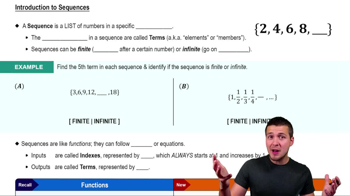
Introduction to Sequences
Limit of a Sequence
The limit of a sequence is the value that the terms approach as n becomes very large. Calculating the limit often involves simplifying the expression and analyzing dominant terms. If the limit exists and is finite, the sequence converges to that limit.
Recommended video:
Guided course
Introduction to Sequences
Dominant Term Analysis
When evaluating limits of sequences involving polynomials, the highest degree terms dominate the behavior as n grows large. By comparing the degrees of numerator and denominator, one can simplify the expression to find the limit, which is crucial for determining convergence.
Recommended video:
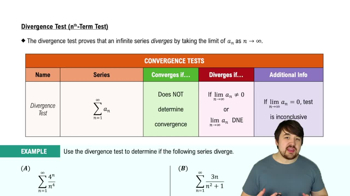
Divergence Test (nth Term Test)
Watch next
Master Introduction to Sequences with a bite sized video explanation from Patrick
Start learningRelated Videos
Related Practice
Multiple Choice
90
views