Absolute maxima and minima Determine the location and value of the absolute extreme values of ƒ on the given interval, if they exist.
ƒ(x) = sec x on [-(π/4),π/4]
Verified step by step guidance
1
First, understand that absolute extrema refer to the highest and lowest values a function can take on a given interval. For the function ƒ(x) = sec(x), we need to find these values on the interval [-(π/4), π/4].
Calculate the derivative of ƒ(x) = sec(x). Recall that the derivative of sec(x) is sec(x)tan(x). This will help us find critical points where the derivative is zero or undefined.
Set the derivative sec(x)tan(x) equal to zero to find critical points. Since sec(x) is never zero, focus on tan(x) = 0. Solve for x to find critical points within the interval [-(π/4), π/4].
Evaluate the function ƒ(x) = sec(x) at the critical points found in the previous step, as well as at the endpoints of the interval, x = -(π/4) and x = π/4.
Compare the values of ƒ(x) at these points to determine the absolute maximum and minimum values on the interval. The largest value will be the absolute maximum, and the smallest will be the absolute minimum.
Verified video answer for a similar problem:
This video solution was recommended by our tutors as helpful for the problem above
Video duration:
6m
Play a video:
Was this helpful?
Key Concepts
Here are the essential concepts you must grasp in order to answer the question correctly.
Absolute Extrema
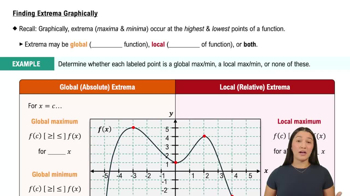
Absolute extrema refer to the highest and lowest values of a function over a specified interval. To find these values, one must evaluate the function at critical points, where the derivative is zero or undefined, as well as at the endpoints of the interval. The largest of these values is the absolute maximum, while the smallest is the absolute minimum.
Critical points are values of the independent variable where the derivative of a function is either zero or undefined. These points are essential in determining the behavior of the function, as they can indicate potential locations for local maxima, minima, or points of inflection. In the context of finding absolute extrema, critical points within the interval must be evaluated alongside the endpoints.
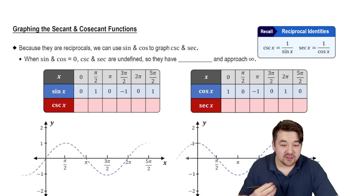
The secant function, denoted as sec(x), is the reciprocal of the cosine function, defined as sec(x) = 1/cos(x). It is important to consider the domain of the secant function, as it is undefined where cos(x) = 0. In the given interval [-(π/4), π/4], the secant function is continuous and differentiable, making it suitable for analysis in finding absolute extrema.