
Verify that the following functions satisfy the conditions of Theorem 4.9 on their domains. Then find the location and value of the absolute extrema guaranteed by the theorem.
f(x) = 4x + 1/√x
Verified step by step guidance
1
Theorem 4.9 is the Extreme Value Theorem, which states that if a function is continuous on a closed interval [a, b], then it must attain an absolute maximum and an absolute minimum on that interval.
First, identify the domain of the function f(x) = 4x + 1/√x. The function is defined for x > 0 because the square root in the denominator requires x to be positive.
Check the continuity of the function on its domain. The function f(x) = 4x + 1/√x is continuous for x > 0, as both terms 4x and 1/√x are continuous for x > 0.
To apply the Extreme Value Theorem, choose a closed interval [a, b] within the domain of f(x). For example, you might choose [1, 2] or any other interval where x > 0.
Find the absolute extrema by evaluating the function at the endpoints of the chosen interval and finding critical points within the interval. Critical points occur where the derivative f'(x) is zero or undefined. Calculate f'(x), set it to zero, and solve for x to find critical points.
Verified video answer for a similar problem:
This video solution was recommended by our tutors as helpful for the problem above
Video duration:
6m
Play a video:
Was this helpful?
Key Concepts
Here are the essential concepts you must grasp in order to answer the question correctly.
Theorem 4.9 (Extreme Value Theorem)
The Extreme Value Theorem states that if a function is continuous on a closed interval [a, b], then it must attain both a maximum and a minimum value at least once within that interval. This theorem is crucial for identifying absolute extrema, as it provides the conditions under which these extrema exist.
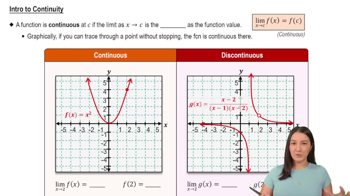
A function is continuous at a point if the limit of the function as it approaches that point equals the function's value at that point. For the Extreme Value Theorem to apply, the function must be continuous over the specified domain, which ensures that there are no breaks, jumps, or asymptotes that could prevent the function from reaching its extrema.
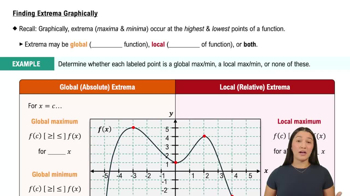
To find the absolute extrema of a function, one typically needs to evaluate the function at critical points (where the derivative is zero or undefined) and at the endpoints of the interval. This process involves taking the derivative, setting it to zero to find critical points, and then comparing the function values at these points and the endpoints to determine the absolute maximum and minimum.