

Ch. 4 - Applications of the Derivative
Briggs - Calculus: Early Transcendentals 3rd Edition
Briggs3rd EditionCalculus: Early TranscendentalsISBN: 9780136847243Not the one you use?Change textbook
Chapter 4, Problem 4.8.58d

{Use of Tech} Fixed points of quadratics and quartics Let f(x) = ax(1 -x), where a is a real number and 0 ≤ a ≤ 1. Recall that the fixed point of a function is a value of x such that f(x) = x (Exercises 48–51). 


d. Find the number and location of the fixed points of g for a = 2, 3, and 4 on the interval 0 ≤ x ≤ 1. 

Verified step by step guidance
1
Understand the concept of a fixed point: A fixed point of a function f(x) is a value x such that f(x) = x. This means that when you substitute x into the function, the output is the same as the input.
Set up the equation for fixed points: For the function f(x) = ax(1 - x), we need to solve the equation ax(1 - x) = x to find the fixed points.
Rearrange the equation: Start by expanding the left side to get ax - ax^2 = x. Then, move all terms to one side to form a quadratic equation: ax - ax^2 - x = 0.
Factor the quadratic equation: Factor the equation ax - ax^2 - x = 0 to find the values of x. This can be done by factoring out x, giving x(a - ax - 1) = 0.
Solve for x: The factored equation x(a - ax - 1) = 0 gives two potential solutions: x = 0 and a - ax - 1 = 0. Solve the second equation for x to find the other fixed points, and analyze these solutions for different values of a (2, 3, and 4) within the interval 0 ≤ x ≤ 1.

Verified video answer for a similar problem:

This video solution was recommended by our tutors as helpful for the problem above.
Video duration:
6m
Was this helpful?

Key Concepts

Here are the essential concepts you must grasp in order to answer the question correctly.

Fixed Points

A fixed point of a function f(x) is a value x such that f(x) = x. This means that when the function is applied to this value, it returns the same value. Finding fixed points often involves solving the equation f(x) - x = 0. In the context of the given function, identifying fixed points helps understand the behavior of the function within a specified interval.
Recommended video:
04:50
Critical Points

Quadratic and Quartic Functions

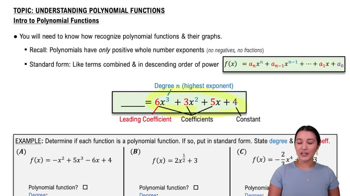
Quadratic functions are polynomial functions of degree two, typically expressed in the form f(x) = ax^2 + bx + c. Quartic functions are of degree four, represented as f(x) = ax^4 + bx^3 + cx^2 + dx + e. The behavior of these functions, including their fixed points, can be analyzed using their graphs, derivatives, and algebraic properties, which are essential for solving the problem at hand.
Recommended video:
6:04
Introduction to Polynomial Functions

Interval Analysis

Interval analysis involves examining the behavior of functions within a specific range, in this case, 0 ≤ x ≤ 1. This is crucial for determining the existence and location of fixed points, as the function's behavior may vary significantly outside this interval. By restricting the analysis to a defined interval, one can apply techniques such as the Intermediate Value Theorem to ascertain the number of fixed points.
Recommended video:
06:29
Derivatives Applied To Velocity
Related Practice
Textbook Question

if ƒ(x) = 1 / (3x⁴ + 5) , it can be shown that ƒ'(x) = 12x³ / (3x⁴ + 5)² and ƒ"(x) = 180x² (x² + 1) (x + 1) (x - 1) / (3x⁴ + 5)³ . Use these functions to complete the following steps.


d. Identify the local extreme values and inflection points of ƒ .

244
views
Textbook Question

Population models The population of a species is given by the function P(t) = Kt²/(t² + b) , where t ≥ 0 is measured in years and K and b are positive real numbers.


c. For arbitrary positive values of K and b, when does the maximum growth rate occur (in terms of K and b)?

338
views
Textbook Question

107–110. {Use of Tech} Motion with gravity Consider the following descriptions of the vertical motion of an object subject only to the acceleration due to gravity. Begin with the acceleration equation a(t) = v' (t) = -g , where g = 9.8 m/s² .

c. Find the time when the object reaches its highest point. What is the height? 

A payload is released at an elevation of 400 m from a hot-air balloon that is rising at a rate of 10 m/s.

50
views
Textbook Question

Rectangles in triangles Find the dimensions and area of the rectangle of maximum area that can be inscribed in the following figures.

d. An arbitrary triangle with a given area A (The result applies to any triangle, but first consider triangles for which all the angles are less than or equal to 90° .)

373
views
Textbook Question

Sketch a graph of a function f with the following properties.


f' < 0 and f" < 0, for 8 < x < 10

264
views
Textbook Question

{Use of Tech} Fixed points of quadratics and quartics Let f(x) = ax(1 -x), where a is a real number and 0 ≤ a ≤ 1. Recall that the fixed point of a function is a value of x such that f(x) = x (Exercises 48–51). 


c. Graph g for a = 2, 3, and 4.

220
views