Splitting up curves The unit circle x² + y² = 1 consists of four one-to-one functions, ƒ₁ (x), ƒ₂(x) , ƒ₃(x), and ƒ₄ (x) (see figure) <IMAGE>.
a. Find the domain and a formula for each function.
Verified step by step guidance
1
Step 1: Recognize that the unit circle x^2 + y^2 = 1 can be split into four segments, each representing a one-to-one function. These segments correspond to the four quadrants of the circle.
Step 2: For each quadrant, determine the range of x-values (domain) and the corresponding y-values. The unit circle is symmetric, so consider the signs of x and y in each quadrant.
Step 3: In the first quadrant, both x and y are positive. The function f_1(x) can be expressed as y = sqrt(1 - x^2) with the domain 0 <= x <= 1.
Step 4: In the second quadrant, x is negative and y is positive. The function f_2(x) can be expressed as y = sqrt(1 - x^2) with the domain -1 <= x <= 0.
Step 5: In the third quadrant, both x and y are negative. The function f_3(x) can be expressed as y = -sqrt(1 - x^2) with the domain -1 <= x <= 0.
Verified video answer for a similar problem:
This video solution was recommended by our tutors as helpful for the problem above
Video duration:
3m
Play a video:
Was this helpful?
Key Concepts
Here are the essential concepts you must grasp in order to answer the question correctly.
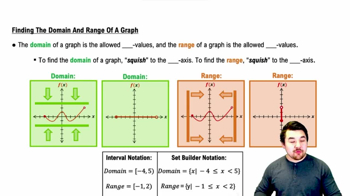
Domain of a Function
The domain of a function refers to the set of all possible input values (x-values) for which the function is defined. For the unit circle equation x² + y² = 1, the domain must be determined by isolating y in terms of x, which leads to two distinct functions for the upper and lower halves of the circle. Understanding the domain is crucial for identifying valid inputs and ensuring the function behaves correctly within its defined limits.
A one-to-one function is a type of function where each output value is associated with exactly one input value, meaning no two different inputs produce the same output. In the context of the unit circle, splitting it into four one-to-one functions allows us to express the circle in a way that each function can be inverted. This property is essential for solving problems that require finding inverse functions or analyzing the behavior of the functions over their respective domains.
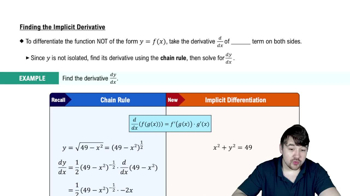
Implicit functions are defined by an equation involving both variables, such as x² + y² = 1, while explicit functions express one variable directly in terms of another, like y = f(x). To find the formulas for the functions ƒ₁(x), ƒ₂(x), ƒ₃(x), and ƒ₄(x) from the unit circle, one must manipulate the implicit equation to derive explicit forms for y. This distinction is vital for understanding how to work with different types of functions in calculus.