Ch. 9 - Differential Equations
Briggs - Calculus: Early Transcendentals 3rd Edition
Briggs3rd EditionCalculus: Early TranscendentalsISBN: 9780136847243Not the one you use?Change textbook
Chapter 9, Problem 9.3.36

33–38. {Use of Tech} Solutions in implicit form Solve the following initial value problems and leave the solution in implicit form. Use graphing software to plot the solution. If the implicit solution describes more than one function, be sure to indicate which function corresponds to the solution of the initial value problem.
yy'(x) = 2x/(2 + y)², y(1) = −1

Verified step by step guidance
1
Rewrite the given differential equation in terms of \( y \) and \( x \). The equation is \( y \frac{dy}{dx} = \frac{2x}{(2 + y)^2} \). Our goal is to separate variables if possible.
Express \( \frac{dy}{dx} \) explicitly: \( \frac{dy}{dx} = \frac{2x}{y(2 + y)^2} \). This suggests separating variables by bringing all \( y \)-terms to one side and \( x \)-terms to the other.
Rewrite the equation as \( y(2 + y)^2 dy = 2x dx \). This sets up the integral form where we integrate both sides with respect to their variables.
Integrate both sides: \( \int y(2 + y)^2 dy = \int 2x dx \). You will need to expand \( (2 + y)^2 \) and then multiply by \( y \) before integrating the left side.
After integrating, apply the initial condition \( y(1) = -1 \) to solve for the constant of integration. The resulting equation will be an implicit solution involving \( x \) and \( y \).

Verified video answer for a similar problem:

This video solution was recommended by our tutors as helpful for the problem above.
Video duration:
5m
Was this helpful?

Key Concepts

Here are the essential concepts you must grasp in order to answer the question correctly.

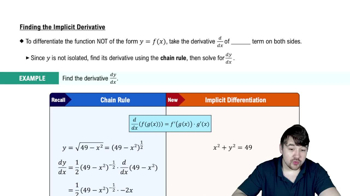
Implicit Differentiation and Implicit Solutions

Implicit differentiation involves finding derivatives when the function is not explicitly solved for one variable. In this problem, the solution is left in implicit form, meaning y is defined by an equation involving both x and y, rather than y expressed explicitly as a function of x.
Recommended video:
05:14
Finding The Implicit Derivative

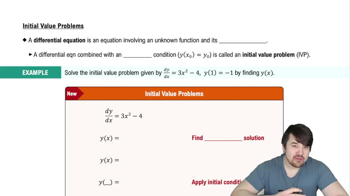
Initial Value Problems (IVPs)

An initial value problem specifies a differential equation along with a condition that the solution must satisfy at a particular point. This condition, y(1) = -1, helps identify the unique solution curve among potentially many implicit solutions.
Recommended video:
05:03
Initial Value Problems

Use of Technology for Graphing Implicit Solutions

Graphing software can plot implicit solutions that are difficult to solve explicitly. It helps visualize the solution curve and distinguish which branch corresponds to the initial condition, especially when the implicit equation defines multiple functions.
Recommended video:
09:16
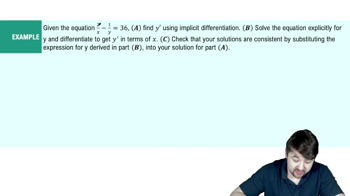
Finding The Implicit Derivative Example 1