Properties of logarithms Assume logbx = 0.36, logby= 0.56 and logbz = 0.83 . Evaluate the following expressions.
logb (√x) / (³√z)
Verified step by step guidance
1
Start by using the properties of logarithms to simplify the expression \( \log_b \left( \frac{\sqrt{x}}{\sqrt[3]{z}} \right) \).
Apply the quotient rule of logarithms: \( \log_b \left( \frac{\sqrt{x}}{\sqrt[3]{z}} \right) = \log_b (\sqrt{x}) - \log_b (\sqrt[3]{z}) \).
Use the power rule of logarithms: \( \log_b (\sqrt{x}) = \log_b (x^{1/2}) = \frac{1}{2} \log_b x \).
Similarly, apply the power rule to \( \log_b (\sqrt[3]{z}) = \log_b (z^{1/3}) = \frac{1}{3} \log_b z \).
Substitute the given values: \( \frac{1}{2} \log_b x = \frac{1}{2} \times 0.36 \) and \( \frac{1}{3} \log_b z = \frac{1}{3} \times 0.83 \), then subtract the two results.
Verified video answer for a similar problem:
This video solution was recommended by our tutors as helpful for the problem above
Video duration:
6m
Play a video:
0 Comments
Key Concepts
Here are the essential concepts you must grasp in order to answer the question correctly.
Properties of Logarithms
The properties of logarithms include rules that simplify the manipulation of logarithmic expressions. Key properties include the product rule (logb(mn) = logb(m) + logb(n)), the quotient rule (logb(m/n) = logb(m) - logb(n)), and the power rule (logb(m^k) = k * logb(m)). Understanding these properties is essential for evaluating complex logarithmic expressions.
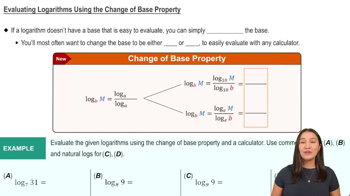
The change of base formula allows the conversion of logarithms from one base to another, expressed as logb(a) = logk(a) / logk(b) for any positive k. This is particularly useful when dealing with logarithms of different bases, enabling easier calculations and comparisons. It is important for evaluating logarithmic expressions when the base is not easily manageable.
Radicals, such as square roots and cube roots, can be expressed in terms of exponents, where √x = x^(1/2) and ³√z = z^(1/3). This relationship is crucial when simplifying logarithmic expressions involving roots, as it allows the application of the power rule of logarithms. Recognizing this connection helps in transforming and evaluating logarithmic expressions effectively.


 6:58 minutes
 Verified step by step guidance
 05:36
05:36