Determine whether the following statements are true and give an explanation or counterexample.
Verified step by step guidance
1
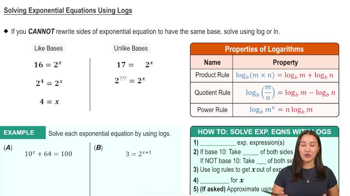
Step 1: Start by applying the power rule of logarithms to the left side of the equation. The power rule states that \( \log_b(a^n) = n \cdot \log_b(a) \). Therefore, \( \log_5(4^6) = 6 \cdot \log_5(4) \).
Step 2: Now, rewrite the right side of the equation, which is \( 4 \cdot \log_5(6) \).
Step 3: Compare the expressions from Step 1 and Step 2. We have \( 6 \cdot \log_5(4) \) on the left and \( 4 \cdot \log_5(6) \) on the right.
Step 4: For the original statement to be true, \( 6 \cdot \log_5(4) \) must equal \( 4 \cdot \log_5(6) \).
Step 5: Consider whether there is a known relationship or property that equates these two expressions, or if a counterexample can be found by evaluating the expressions numerically.
Verified video answer for a similar problem:
This video solution was recommended by our tutors as helpful for the problem above
Video duration:
1m
Play a video:
Was this helpful?
Key Concepts
Here are the essential concepts you must grasp in order to answer the question correctly.
Logarithmic Properties
Logarithmic properties are rules that govern the manipulation of logarithms. Key properties include the product rule, quotient rule, and power rule. For instance, the power rule states that \\log_b(a^n) = n \\log_b(a), which allows us to simplify expressions involving exponents. Understanding these properties is essential for evaluating and comparing logarithmic expressions.
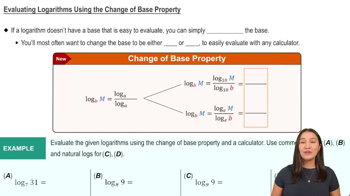
The change of base formula allows us to convert logarithms from one base to another, expressed as \\log_b(a) = \\frac{\\log_k(a)}{\\log_k(b)} for any positive base k. This is particularly useful when dealing with logarithms that are not easily computable in their original base. It helps in simplifying complex logarithmic equations and verifying their equality.
Exponential equations involve expressions where variables appear as exponents. Understanding how to manipulate these equations is crucial for solving logarithmic statements. For example, if \\log_b(a) = c, then it can be rewritten in exponential form as \\ b^c = a. This relationship is fundamental in proving or disproving logarithmic identities and statements.