First, recognize that the expression involves the natural logarithm function ln and the exponential function e. The expression is e raised to the power of x times ln(x² + 1).
Use the property of logarithms that states ln(a^b) = b * ln(a). In this case, you can rewrite ln(x² + 1) as ln((x² + 1)^1), which is simply ln(x² + 1).
Next, apply the property of exponents that states e^(a * ln(b)) = b^a. This allows you to simplify e^(x * ln(x² + 1)) to (x² + 1)^x.
Now, the expression is simplified to (x² + 1)^x. This is the simplified form of the original expression.
Finally, verify the simplification by considering the properties used: the logarithmic identity and the exponential identity. Ensure that each step logically follows from the previous one.
Verified video answer for a similar problem:
This video solution was recommended by our tutors as helpful for the problem above
Video duration:
2m
Play a video:
Was this helpful?
Key Concepts
Here are the essential concepts you must grasp in order to answer the question correctly.
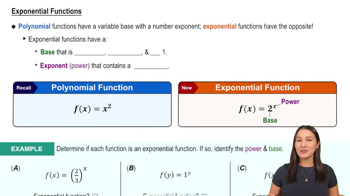
Exponential Functions
Exponential functions are mathematical expressions in the form of a constant raised to a variable exponent, commonly represented as e^x, where e is Euler's number (approximately 2.718). These functions exhibit unique properties, such as the derivative of e^x being e^x itself, which is crucial for simplification and differentiation in calculus.
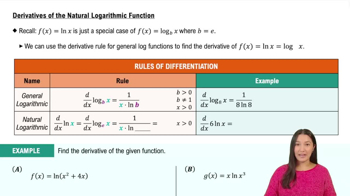
The natural logarithm, denoted as ln(x), is the logarithm to the base e. It is the inverse function of the exponential function, meaning that if y = ln(x), then e^y = x. Understanding the properties of logarithms, such as ln(a*b) = ln(a) + ln(b), is essential for simplifying expressions involving logarithmic terms.
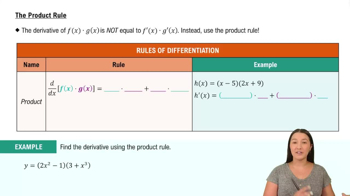
The product rule is a fundamental principle in calculus used to differentiate products of two functions. It states that if u(x) and v(x) are two differentiable functions, then the derivative of their product is given by u'v + uv'. This rule is important when simplifying expressions that involve products of functions, such as e^x and ln(x²+1) in the given expression.