What is the polar equation of the horizontal line y = 5?
Table of contents
- 0. Functions7h 54m
- Introduction to Functions16m
- Piecewise Functions10m
- Properties of Functions9m
- Common Functions1h 8m
- Transformations5m
- Combining Functions27m
- Exponent rules32m
- Exponential Functions28m
- Logarithmic Functions24m
- Properties of Logarithms36m
- Exponential & Logarithmic Equations35m
- Introduction to Trigonometric Functions38m
- Graphs of Trigonometric Functions44m
- Trigonometric Identities47m
- Inverse Trigonometric Functions48m
- 1. Limits and Continuity2h 2m
- 2. Intro to Derivatives1h 33m
- 3. Techniques of Differentiation3h 18m
- 4. Applications of Derivatives2h 38m
- 5. Graphical Applications of Derivatives6h 2m
- 6. Derivatives of Inverse, Exponential, & Logarithmic Functions2h 37m
- 7. Antiderivatives & Indefinite Integrals1h 26m
- 8. Definite Integrals4h 44m
- 9. Graphical Applications of Integrals2h 27m
- 10. Physics Applications of Integrals 3h 16m
- 11. Integrals of Inverse, Exponential, & Logarithmic Functions2h 34m
- 12. Techniques of Integration7h 41m
- 13. Intro to Differential Equations2h 55m
- 14. Sequences & Series5h 36m
- 15. Power Series2h 19m
- 16. Parametric Equations & Polar Coordinates7h 58m
16. Parametric Equations & Polar Coordinates
Polar Coordinates
Problem 12.2.16
Textbook Question
15–22. Sets in polar coordinates Sketch the following sets of points.
r = 3
Verified step by step guidance1
Understand that the equation \(r = 3\) in polar coordinates represents all points that are at a distance of 3 units from the origin (pole).
Recall that in polar coordinates, \(r\) is the radius or distance from the origin, and \(\theta\) is the angle measured from the positive x-axis.
Since \(r\) is constant and equal to 3, this means the set of points forms a circle centered at the origin with radius 3.
To sketch this, draw a circle with center at the origin (0,0) and radius 3 units on the polar coordinate plane.
Label the circle and note that it includes all points where \(r = 3\) for any angle \(\theta\) between \$0\( and \)2\pi$.
Verified video answer for a similar problem:This video solution was recommended by our tutors as helpful for the problem above
Video duration:
2mPlay a video:
Was this helpful?
Key Concepts
Here are the essential concepts you must grasp in order to answer the question correctly.
Polar Coordinates System
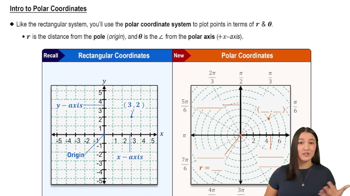
The polar coordinate system represents points in a plane using a radius and an angle, denoted as (r, θ). Here, r is the distance from the origin, and θ is the angle measured from the positive x-axis. This system is especially useful for describing curves and regions with circular symmetry.
Recommended video:
Intro to Polar Coordinates
Graphing r = Constant in Polar Coordinates
The equation r = 3 describes all points that are exactly 3 units away from the origin, regardless of the angle θ. Graphically, this set forms a circle centered at the origin with radius 3. Understanding this helps in sketching curves defined by constant radius values.
Recommended video:
Intro to Polar Coordinates
Conversion Between Polar and Cartesian Coordinates
To better visualize or analyze polar equations, converting between polar (r, θ) and Cartesian (x, y) coordinates is useful. The formulas x = r cos θ and y = r sin θ allow translation of points, enabling the use of familiar Cartesian graphing techniques for polar curves.
Recommended video:
Intro to Polar Coordinates
Watch next
Master Intro to Polar Coordinates with a bite sized video explanation from Patrick
Start learningRelated Videos
Related Practice
Textbook Question
15
views