Write the equations that are used to express a point with polar coordinates (r, θ) in Cartesian coordinates.
Table of contents
- 0. Functions7h 54m
- Introduction to Functions16m
- Piecewise Functions10m
- Properties of Functions9m
- Common Functions1h 8m
- Transformations5m
- Combining Functions27m
- Exponent rules32m
- Exponential Functions28m
- Logarithmic Functions24m
- Properties of Logarithms36m
- Exponential & Logarithmic Equations35m
- Introduction to Trigonometric Functions38m
- Graphs of Trigonometric Functions44m
- Trigonometric Identities47m
- Inverse Trigonometric Functions48m
- 1. Limits and Continuity2h 2m
- 2. Intro to Derivatives1h 33m
- 3. Techniques of Differentiation3h 18m
- 4. Applications of Derivatives2h 38m
- 5. Graphical Applications of Derivatives6h 2m
- 6. Derivatives of Inverse, Exponential, & Logarithmic Functions2h 37m
- 7. Antiderivatives & Indefinite Integrals1h 26m
- 8. Definite Integrals4h 44m
- 9. Graphical Applications of Integrals2h 27m
- 10. Physics Applications of Integrals 3h 16m
- 11. Integrals of Inverse, Exponential, & Logarithmic Functions2h 34m
- 12. Techniques of Integration7h 41m
- 13. Intro to Differential Equations2h 55m
- 14. Sequences & Series5h 36m
- 15. Power Series2h 19m
- 16. Parametric Equations & Polar Coordinates7h 58m
16. Parametric Equations & Polar Coordinates
Polar Coordinates
Problem 12.2.13
Textbook Question
9–13. Graph the points with the following polar coordinates. Give two alternative representations of the points in polar coordinates.
(-4, 3π/2)
Verified step by step guidance1
Recall that a point in polar coordinates is given as \((r, \theta)\), where \(r\) is the radius (distance from the origin) and \(\theta\) is the angle measured from the positive x-axis.
Plot the point \((-4, \frac{3\pi}{2})\) by first considering the angle \(\frac{3\pi}{2}\), which corresponds to the downward direction along the negative y-axis.
Since \(r\) is negative, move in the opposite direction of the angle \(\frac{3\pi}{2}\). This means you move 4 units upward (opposite to downward) along the positive y-axis.
To find two alternative representations, use the fact that adding \$2\pi\( to the angle does not change the point, and changing the sign of \)r\( while adding \)\pi$ to the angle gives the same point. So, the alternatives are:
1) \((r, \theta + 2\pi) = (-4, \frac{3\pi}{2} + 2\pi)\) and 2) \((-r, \theta + \pi) = (4, \frac{3\pi}{2} + \pi)\). Write these explicitly as your alternative polar coordinates.
Verified video answer for a similar problem:This video solution was recommended by our tutors as helpful for the problem above
Video duration:
1mPlay a video:
Was this helpful?
Key Concepts
Here are the essential concepts you must grasp in order to answer the question correctly.
Polar Coordinates System
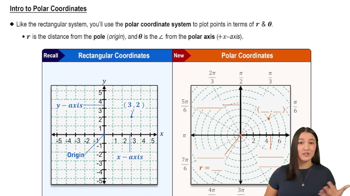
Polar coordinates represent points in a plane using a radius and an angle, denoted as (r, θ). The radius r is the distance from the origin, and θ is the angle measured from the positive x-axis. This system is useful for describing locations in circular or rotational contexts.
Recommended video:
Intro to Polar Coordinates
Graphing Points in Polar Coordinates
To graph a point (r, θ), start at the origin, rotate counterclockwise by angle θ, then move outward (or inward if r is negative) by distance r. Negative radius values mean moving in the opposite direction of the angle, which affects the point's position on the plane.
Recommended video:
Intro to Polar Coordinates
Alternative Representations of Polar Coordinates
A single point can have multiple polar coordinate representations by adding or subtracting full rotations (2π) to the angle or by changing the sign of the radius and adjusting the angle by π. For example, (r, θ) is equivalent to (-r, θ + π) and (r, θ + 2πk) for any integer k.
Recommended video:
Intro to Polar Coordinates
Watch next
Master Intro to Polar Coordinates with a bite sized video explanation from Patrick
Start learningRelated Videos
Related Practice
Textbook Question
7
views