
Demand function Sales records indicate that if Blu-ray players are priced at \$250, then a large store sells an average of 12 units per day. If they are priced at \$200, then the store sells an average of 15 units per day. Find and graph the linear demand function for Blu-ray sales. For what prices is the demand function defined?
Ch. 1 - Functions
Briggs3rd EditionCalculus: Early TranscendentalsISBN: 9780136847243Not the one you use?Change textbook
Chapter 1, Problem 23
Where do inverses exist? Use analytical and/or graphical methods to determine the largest possible sets of points on which the following functions have an inverse.
{Use of Tech} ƒ(x) = 1/(x-5)
Verified step by step guidance1
Step 1: Understand the concept of an inverse function. An inverse function exists if a function is one-to-one (bijective), meaning it passes the horizontal line test. This implies that for every y-value, there is exactly one x-value.
Step 2: Analyze the function \( f(x) = \frac{1}{x-5} \). Notice that this is a rational function with a vertical asymptote at \( x = 5 \), where the function is undefined.
Step 3: Consider the domain of \( f(x) \). The function is defined for all real numbers except \( x = 5 \). Therefore, the domain is \( (-\infty, 5) \cup (5, \infty) \).
Step 4: Check if the function is one-to-one on its domain. Since \( f(x) = \frac{1}{x-5} \) is a strictly decreasing function on each interval \( (-\infty, 5) \) and \( (5, \infty) \), it passes the horizontal line test on these intervals.
Step 5: Conclude that the function \( f(x) = \frac{1}{x-5} \) has an inverse on each of the intervals \( (-\infty, 5) \) and \( (5, \infty) \), as it is one-to-one on these intervals.

Verified video answer for a similar problem:
This video solution was recommended by our tutors as helpful for the problem above.
Video duration:
3mWas this helpful?
Key Concepts
Here are the essential concepts you must grasp in order to answer the question correctly.
Inverse Functions
An inverse function essentially reverses the effect of the original function. For a function f(x), its inverse f⁻¹(x) satisfies the condition f(f⁻¹(x)) = x for all x in the domain of f⁻¹. A function has an inverse if it is one-to-one, meaning it passes the horizontal line test, where no horizontal line intersects the graph of the function more than once.
Recommended video:
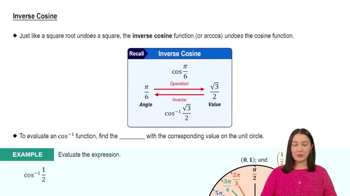
Inverse Cosine
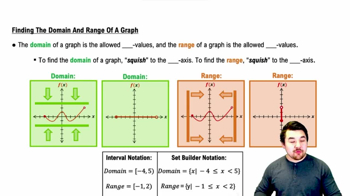
Domain and Range
The domain of a function is the set of all possible input values (x-values) for which the function is defined, while the range is the set of all possible output values (y-values). Understanding the domain and range is crucial for determining where a function is invertible, as the range of the original function becomes the domain of its inverse.
Recommended video:
Finding the Domain and Range of a Graph
Horizontal Line Test
The horizontal line test is a graphical method used to determine if a function is one-to-one. If any horizontal line intersects the graph of the function more than once, the function fails the test and does not have an inverse. This test is particularly useful for visualizing the behavior of functions and identifying intervals where they may be invertible.
Recommended video:
Slopes of Tangent Lines
Related Practice
Textbook Question
359
views
Textbook Question
Find the inverse function (on the given interval, if specified) and graph both and on the same set of axes. Check your work by looking for the required symmetry in the graphs.
381
views
Textbook Question
Evaluating trigonometric functions Without using a calculator, evaluate the following expressions or state that the quantity is undefined.
sec (7π/6)
300
views
Textbook Question
The population of a small town was 500 in 2018 and is growing at a rate of 24 people per year. Find and graph the linear population function p(t) that gives the population of the town t years after 2018. Then use this model to predict the population in 2033.
587
views
Textbook Question
Evaluating trigonometric functions Without using a calculator, evaluate the following expressions or state that the quantity is undefined.
tan (15π/4)
315
views
