
Textbook Question
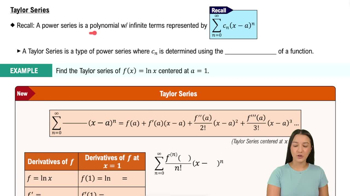
Taylor series
b. Write the power series using summation notation.
f(x) = 1/x, a = 1
118
views

 Verified step by step guidance
 04:57
04:57
 08:42 04:57
Taylor series
b. Write the power series using summation notation.
f(x) = 1/x, a = 1
{Use of Tech} Small argument approximations Consider the following common approximations when x is near zero.
b. Estimate f(0.2) and give a bound on the error in the approximation.
f(x) = ln (1 + x) ≈ x − x²/2
Probability: sudden−death playoff Teams A and B go into suddendeath overtime after playing to a tie. The teams alternate possession of the ball, and the first team to score wins. Assume each team has a 1/6 chance of scoring when it has the ball, and Team A has the ball first.
b. The expected number of rounds (possessions by either team) required for the overtime to end is (1/6) ∑ₖ₌₁∞ k(5/6)ᵏ⁻¹. Evaluate this series.
Taylor series and interval of convergence
b. Write the power series using summation notation.
f(x) = e²ˣ, a = 0
Sine integral function The function Si(x) = ∫₀ˣ f(t) dt, where f(t) = {(sin t)/t if t ≠ 0, 1 if t = 0, is called the sine integral function.
b. Integrate the series to find a Taylor series for Si.
Taylor series
b. Write the power series using summation notation.
f(x) = ln x, a = 3