Area of a circular sector Prove that the area of a sector of a circle of radius r associated with a central angle θ (measured in radians) is A=21r2θ. <IMAGE>
Verified step by step guidance
1
Start by understanding the relationship between the area of a circle and the area of a sector. The area of a full circle with radius r is given by the formula A = \pi r^2.
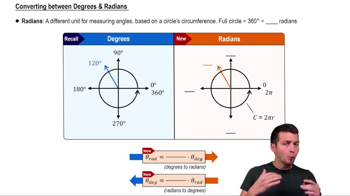
Recognize that a sector is a portion of the circle, defined by a central angle \( \theta \) (in radians). The fraction of the circle's area that the sector occupies is \( \frac{\theta}{2\pi} \), since the full circle corresponds to an angle of \( 2\pi \) radians.
Calculate the area of the sector by multiplying the fraction of the circle's area by the total area of the circle: \( A_{\text{sector}} = \frac{\theta}{2\pi} \times \pi r^2 \).
Conclude that the area of the sector is \( A = \frac{1}{2} r^2 \theta \), which is the desired formula.
Verified video answer for a similar problem:
This video solution was recommended by our tutors as helpful for the problem above
Video duration:
2m
Play a video:
Was this helpful?
Key Concepts
Here are the essential concepts you must grasp in order to answer the question correctly.
Central Angle
A central angle is formed by two radii of a circle that meet at the center. It is measured in degrees or radians, with one full rotation around the circle equating to 360 degrees or 2π radians. Understanding central angles is crucial for calculating the area of a sector, as the area is directly proportional to the angle's measure.
A sector of a circle is a portion of the circle enclosed by two radii and the arc between them. The area of a sector can be calculated using the formula A = (1/2)r²θ, where r is the radius and θ is the central angle in radians. This concept is essential for solving problems related to circular areas and understanding how angles affect the size of the sector.
Radians are a unit of angular measure used in mathematics, particularly in calculus and trigonometry. One radian is defined as the angle subtended at the center of a circle by an arc whose length is equal to the radius of the circle. Radians provide a natural way to relate angles to arc lengths and areas, making them fundamental for deriving formulas like the area of a sector.