Find functions ƒand g such that ƒ(g(x)) = (x² +1)⁵ . Find a different pair of functions ƒ and g that also satisfy ƒ(g(x)) = (x² +1)⁵
Verified step by step guidance
1
Consider the composition of functions \( f(g(x)) = (x^2 + 1)^5 \). We need to find functions \( f \) and \( g \) such that their composition results in this expression.
First, let's choose \( g(x) = x^2 + 1 \). This simplifies the inner function.
Now, we need to find \( f \) such that \( f(g(x)) = f(x^2 + 1) = (x^2 + 1)^5 \). This implies \( f(u) = u^5 \) where \( u = g(x) \).
For a different pair, let's choose \( g(x) = x \). This means we need \( f(x) = (x^2 + 1)^5 \) to satisfy the composition.
Thus, the first pair is \( f(u) = u^5 \) and \( g(x) = x^2 + 1 \), and the second pair is \( f(x) = (x^2 + 1)^5 \) and \( g(x) = x \).
Verified video answer for a similar problem:
This video solution was recommended by our tutors as helpful for the problem above
Video duration:
4m
Play a video:
Was this helpful?
Key Concepts
Here are the essential concepts you must grasp in order to answer the question correctly.
Composition of Functions
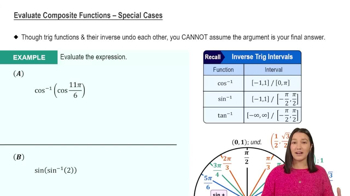
The composition of functions involves combining two functions, where the output of one function becomes the input of another. This is denoted as ƒ(g(x)), meaning you first apply g to x, and then apply ƒ to the result. Understanding this concept is crucial for solving the problem, as it requires finding two functions that, when composed, yield a specific result.
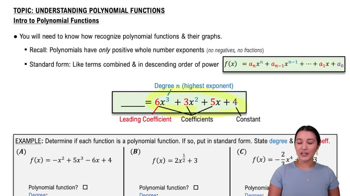
Polynomial functions are expressions that involve variables raised to whole number powers, combined using addition, subtraction, and multiplication. The function (x² + 1)⁵ is a polynomial function raised to a power, which can be expanded using the binomial theorem. Recognizing the structure of polynomial functions helps in identifying potential forms for ƒ and g that can achieve the desired composition.
Function decomposition is the process of breaking down a complex function into simpler component functions. In this context, it involves finding two distinct functions ƒ and g such that their composition results in (x² + 1)⁵. This concept is essential for exploring different pairs of functions that can satisfy the given equation, allowing for creative solutions and insights into function behavior.