Find the following limits or state that they do not exist. Assume a, b , c, and k are fixed real numbers.
lim x→−95x
Verified step by step guidance
1
Identify the type of limit: This is a limit of a linear function as \( x \) approaches a constant.
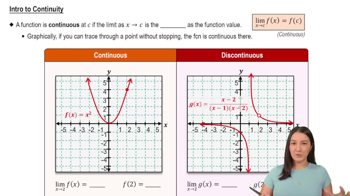
Recognize that the function \( 5x \) is continuous everywhere, including at \( x = -95 \).
Apply the property of limits for continuous functions: \( \lim_{x \to a} f(x) = f(a) \).
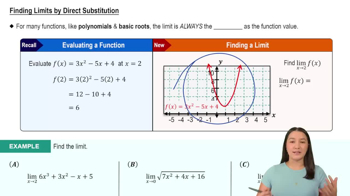
Substitute \( x = -95 \) into the function \( 5x \) to evaluate the limit.
Conclude that the limit exists and is equal to the value of the function at \( x = -95 \).
Verified video answer for a similar problem:

This video solution was recommended by our tutors as helpful for the problem above
Video duration:
2m
Play a video:
Was this helpful?
Key Concepts
Here are the essential concepts you must grasp in order to answer the question correctly.
Limits
A limit is a fundamental concept in calculus that describes the behavior of a function as its input approaches a certain value. It helps in understanding how functions behave near specific points, which is crucial for defining derivatives and integrals. In this case, we are interested in the limit of the function as x approaches -9.
A function is continuous at a point if the limit of the function as it approaches that point equals the function's value at that point. Continuous functions do not have breaks, jumps, or holes, making it easier to evaluate limits. The function 5x is continuous everywhere, which simplifies the process of finding its limit.
Substitution is a technique used in limit evaluation where you directly replace the variable in the function with the value it approaches. If the function is continuous at that point, this method yields the limit's value. For the limit lim x→−95x, substituting -9 directly into the function will provide the limit's value.