
What is the inverse function of ln x, and what are its domain and range?
Verified step by step guidance
1
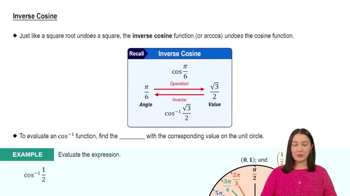
The inverse function of ln(x) is the exponential function, denoted as e^x. This is because the natural logarithm ln(x) and the exponential function e^x are inverse operations of each other.
To find the inverse function, start by setting y = ln(x). Then rewrite the equation in exponential form: x = e^y. This shows that the inverse function of ln(x) is f^(-1)(x) = e^x.
The domain of the natural logarithm function ln(x) is (0, ∞), meaning it is defined for all positive real numbers. Therefore, the range of its inverse function, e^x, is also (0, ∞).
The range of the natural logarithm function ln(x) is (-∞, ∞), meaning it can output any real number. Therefore, the domain of its inverse function, e^x, is also (-∞, ∞).
In summary, the inverse function of ln(x) is f^(-1)(x) = e^x, with a domain of (-∞, ∞) and a range of (0, ∞).
Verified video answer for a similar problem:
This video solution was recommended by our tutors as helpful for the problem above
Video duration:
2m
Play a video:
Was this helpful?
Key Concepts
Here are the essential concepts you must grasp in order to answer the question correctly.
Inverse Functions
An inverse function essentially reverses the effect of the original function. For a function f(x), its inverse f⁻¹(x) satisfies the condition f(f⁻¹(x)) = x for all x in the domain of f⁻¹. Understanding how to find the inverse involves swapping the roles of the input and output and solving for the new output.
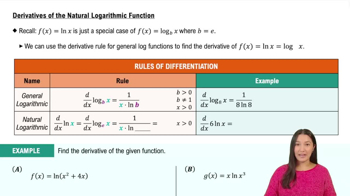
The natural logarithm, denoted as ln x, is the logarithm to the base e, where e is approximately 2.718. It is defined for positive real numbers, and its output is the exponent to which e must be raised to obtain x. The function ln x is crucial in calculus for solving exponential equations and understanding growth processes.
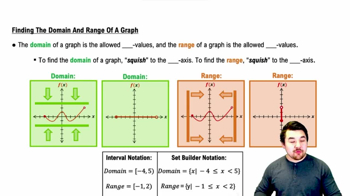
The domain of a function is the set of all possible input values (x-values) for which the function is defined, while the range is the set of all possible output values (y-values). For the natural logarithm ln x, the domain is (0, ∞) since it is only defined for positive x, and the range is (-∞, ∞) because ln x can take any real number as its output.