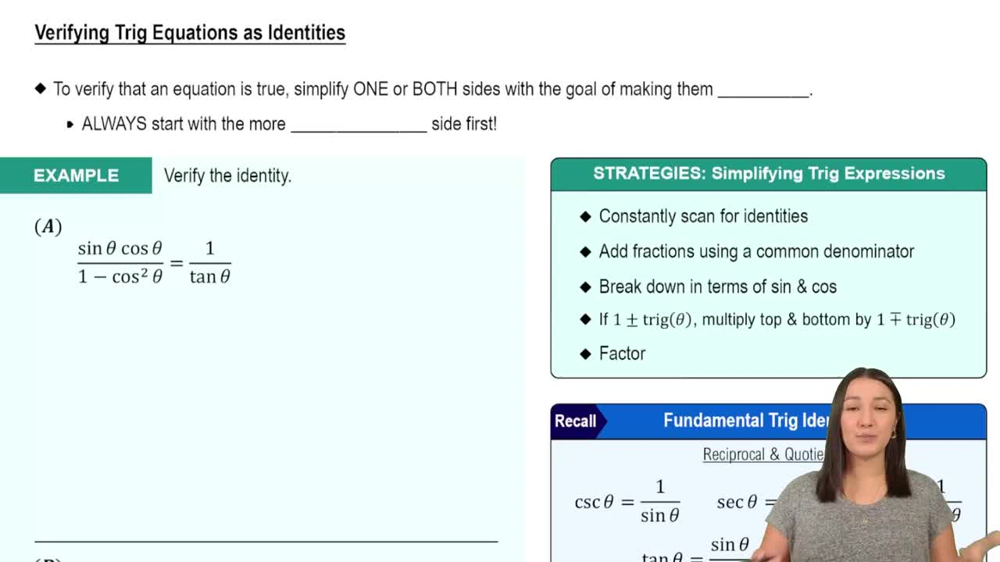
Verify the identity sec⁻¹ x = cos⁻¹ (1/x), for x ≠ 0.
Verified step by step guidance
1
Start by understanding the definitions: sec⁻¹(x) is the inverse secant function, which gives the angle whose secant is x. Similarly, cos⁻¹(y) is the inverse cosine function, which gives the angle whose cosine is y.
Recall the relationship between secant and cosine: sec(θ) = 1/cos(θ). Therefore, if θ = sec⁻¹(x), then sec(θ) = x, which implies cos(θ) = 1/x.
Express the angle θ in terms of cosine: Since cos(θ) = 1/x, we can write θ = cos⁻¹(1/x).
Thus, if θ = sec⁻¹(x), then θ = cos⁻¹(1/x), which verifies the identity sec⁻¹(x) = cos⁻¹(1/x).
Ensure the domain is correct: The identity holds for x ≠ 0, as secant and cosine are defined for these values, and 1/x is valid when x is not zero.
Verified video answer for a similar problem:
This video solution was recommended by our tutors as helpful for the problem above
Video duration:
3m
Play a video:
0 Comments
Key Concepts
Here are the essential concepts you must grasp in order to answer the question correctly.
Inverse Trigonometric Functions
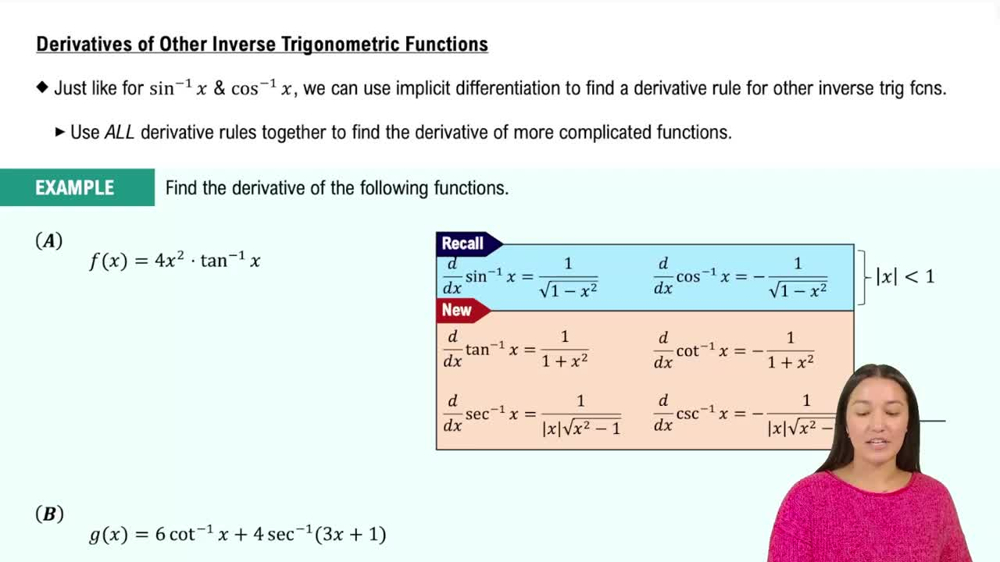
Inverse trigonometric functions, such as sec⁻¹ (arcsec) and cos⁻¹ (arccos), are used to find angles when given a ratio. The arcsec function returns the angle whose secant is x, while the arccos function returns the angle whose cosine is 1/x. Understanding these functions is crucial for verifying identities involving trigonometric ratios.
Derivatives of Other Inverse Trigonometric Functions
Trigonometric Identities
Trigonometric identities are equations that involve trigonometric functions and are true for all values of the variables involved. The identity sec(θ) = 1/cos(θ) is fundamental in relating secant and cosine functions. Recognizing and applying these identities is essential for proving relationships between different trigonometric functions.
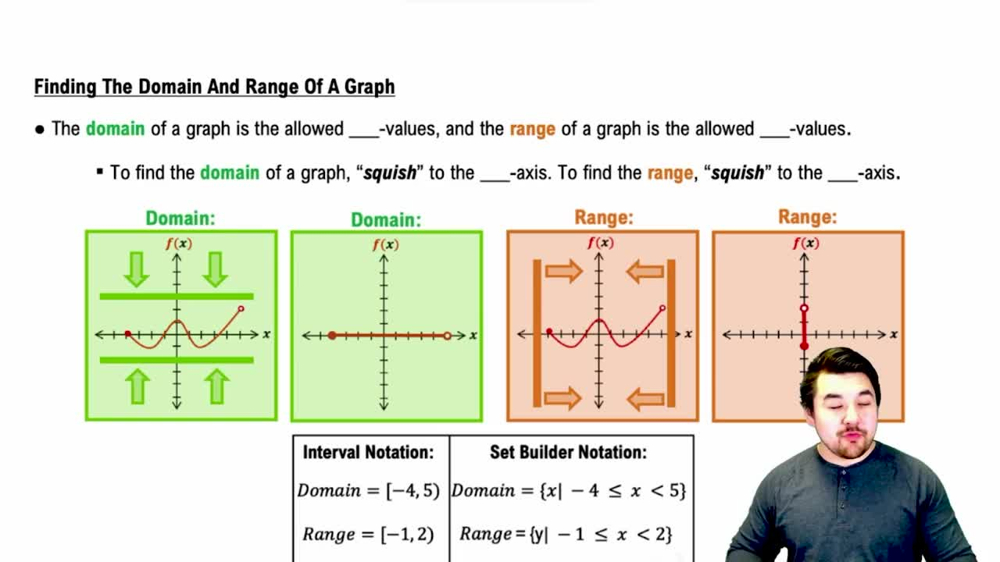
The domain and range of functions define the set of input values (domain) and the set of possible output values (range). For sec⁻¹ x, the domain is x ≤ -1 or x ≥ 1, while for cos⁻¹ (1/x), the domain is restricted to x ≤ -1 or x ≥ 1 as well. Understanding these constraints is vital for ensuring the validity of the identity being verified.

 3:50 minutes
 Verified step by step guidance
 06:35
06:35