b. Prove that tan⁻¹ x + tan⁻¹ x(1/x) = π/2, for x > 0.
Verified step by step guidance
1
Start by recalling the inverse tangent identity: \( \tan^{-1}(x) + \tan^{-1}(y) = \tan^{-1}\left(\frac{x + y}{1 - xy}\right) \) when \( xy < 1 \).
In this problem, set \( y = \frac{1}{x} \). Substitute \( y \) into the identity: \( \tan^{-1}(x) + \tan^{-1}\left(\frac{1}{x}\right) = \tan^{-1}\left(\frac{x + \frac{1}{x}}{1 - x \cdot \frac{1}{x}}\right) \).
Simplify the expression inside the inverse tangent: \( \frac{x + \frac{1}{x}}{1 - 1} = \frac{x + \frac{1}{x}}{0} \).
Recognize that the denominator becomes zero, which implies the expression approaches infinity. The inverse tangent of infinity is \( \frac{\pi}{2} \).
Conclude that \( \tan^{-1}(x) + \tan^{-1}\left(\frac{1}{x}\right) = \frac{\pi}{2} \) for \( x > 0 \), as the expression inside the inverse tangent approaches infinity.
Verified video answer for a similar problem:
This video solution was recommended by our tutors as helpful for the problem above
Video duration:
3m
Play a video:
Was this helpful?
Key Concepts
Here are the essential concepts you must grasp in order to answer the question correctly.
Inverse Tangent Function
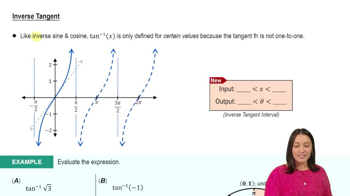
The inverse tangent function, denoted as tan⁻¹(x) or arctan(x), is the function that returns the angle whose tangent is x. It is defined for all real numbers and has a range of (-π/2, π/2). Understanding this function is crucial for manipulating and proving identities involving angles.
Trigonometric identities are equations that involve trigonometric functions and are true for all values of the variables involved. One important identity is that the sum of the angles whose tangents are x and 1/x equals π/2, which reflects the complementary nature of these angles. This identity is essential for proving the given statement.
Complementary angles are two angles whose sum is π/2 radians (or 90 degrees). In the context of the problem, if θ = tan⁻¹(x), then the angle whose tangent is 1/x is π/2 - θ. Recognizing this relationship is key to proving the identity tan⁻¹(x) + tan⁻¹(1/x) = π/2 for x > 0.